

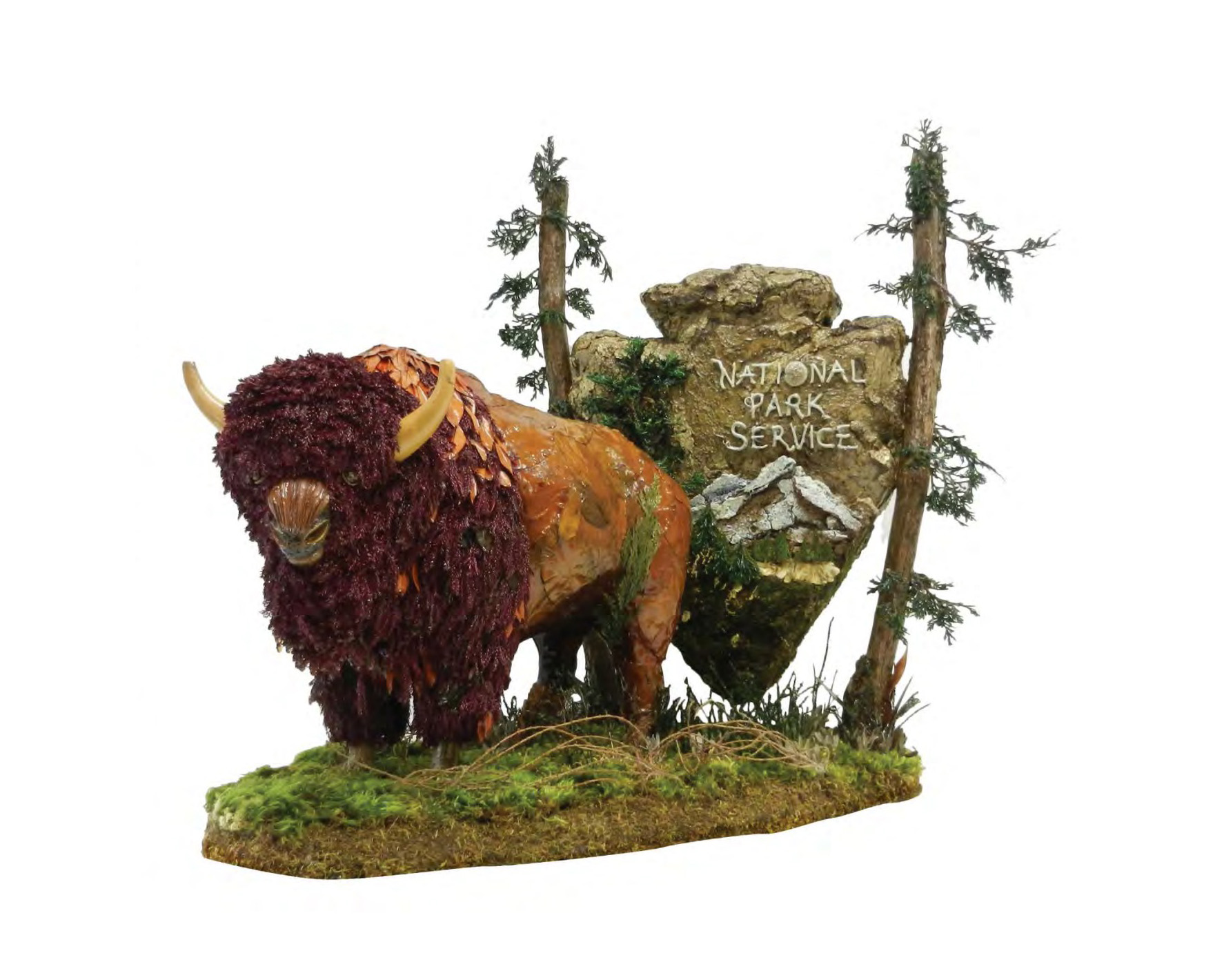
National Park Emblem & National Park Service Mascot
Grand Canyon Village Historic District, Arizona
Sponsored by Carlene Lebous & Harris Haston
The American bison, America’s national mammal, and the iconic National Park Service arrowhead. The arrowhead was authorized as the official National Park Service emblem by the Secretary of the Interior on July 20, 1951. The elements of the emblem symbolize the major facets of the national park system. The sequoia tree and bison represent vegetation and wildlife, the mountains and water represent scenic and recreational values, and the arrowhead represents historical and archaeological values.
Botanical Materials:
Bison Body: salal leaves, palm fiber, cedar basil fronds, honeysuckle sticks, princess fern
Bison Nose: arti pods
Bison Horns: gourds
Logo: horse chestnut bark, turkey tail fungus, Harry Lauder’s walking sticks, juniper
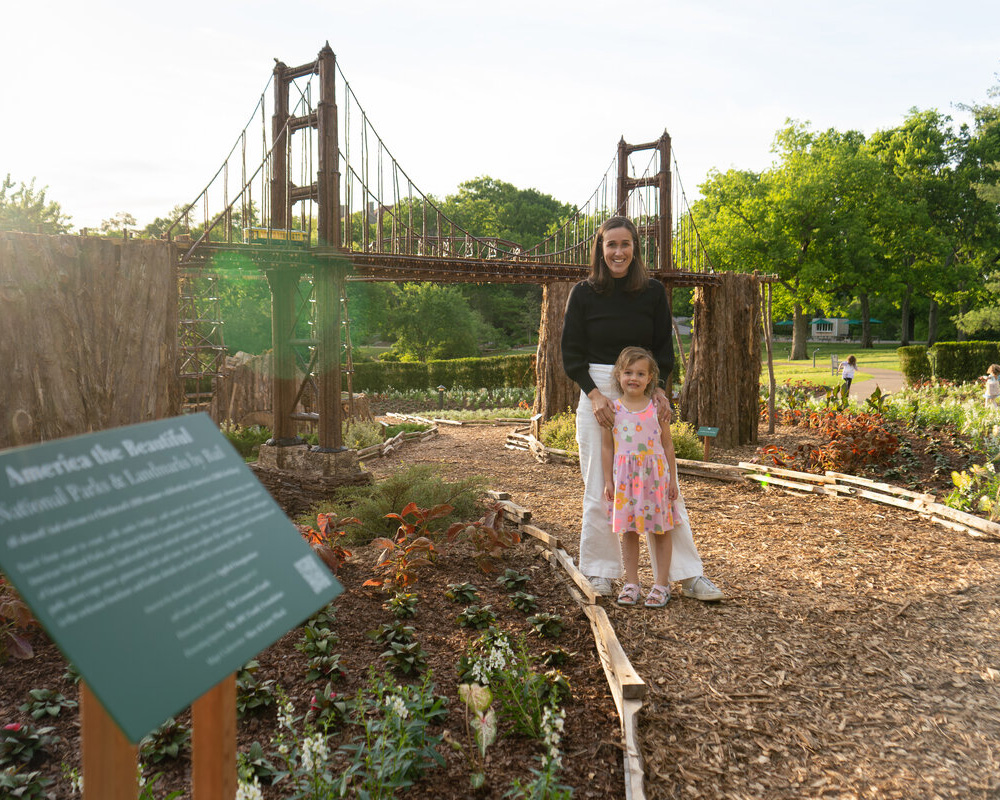
Golden Gate Bridge
San Francisco, California
Golden Gate National Recreation Area
The Golden Gate Bridge is a suspension bridge spanning the Golden Gate, the one-mile-wide strait connecting San Francisco Bay and the Pacific Ocean in California, United States. The structure links the northern tip of the San Francisco Peninsula to Marin County, carrying both U.S. Route 101 and California State Route 1 across the strait. Recognized by the American Society of Civil Engineers as one of the Wonders of the Modern World, the bridge is one of the most internationally recognized symbols of San Francisco and California. At its opening in 1937, it was both the longest and the tallest suspension bridge in the world, titles it held until 1964 and 1998, respectively.
Botanical Materials:
Willow branches, Cedar wood, acorn caps, shelf fungus, mahogany pods, estrella pods, locust bark, horse chestnut bark.
John Muir House
Martinez, California
As a young man, John Muir studied biology, botany, and geology. With a plant press in his backpack, Muir walked more than 1,000 miles from Kentucky to the Gulf of Mexico, gathering specimens. His curiosity carried him to California and Alaska, where he tracked the movements of glaciers. Muir’s descriptions of glaciers and sequoias brought the beauty of nature to readers nationwide. Muir’s popular writings caught the attention of President Theodore Roosevelt, who set aside more than 230 million acres of public land that included five national parks and 18 national monuments. Muir’s advocacy helped create several national parks, including Sequoia (1890), Mount Rainier (1899), and Grand Canyon (1908).
Botanical Materials:
Roof: cottonwood bark, cedar, reed
Facade: grout
Door: winged euonymous, cedar, birch
Windows: winged euonymous, reed
Window Trim: cinnamon, acorn cap, cedrela, Australian pine fruit, royal poinciana seed, cedar, oak bark, tallow berry
Center Window: pear-shaped pod, poppy pod
Steps & Porches: cedar Corner Stone: pine bark
Chimneys: driftwood, acorn cap Columns: honeysuckle vine, acorn cap, sino calycanthus
Railing: honeysuckle, magnolia fruit stems
Balcony: acorn cap, Harry Lauder’s walking sticks, anise, poppy pod, mahogany pod, dawn redwood cones, Japanese snowbelI pods
Top Trim: acorn cap, cedrela, Australian pine fruit, Japanese snowbell seed, clove, salt cedar stick
Tharp’s Log
Sequoia National Park, California
Once used as a shelter by early pioneers, this structure is a hollowed-out giant sequoia log that was crafted by a pioneer named Hale Tharp.
Botanical Materials:
Cedar, sequoia bark, locust bark, stones, moss, shelf fungus, Harry Lauder’s walking sticks, Natraj
Iolani Palace
Honolulu, Hawaii
One of the most important landmarks in Hawaiian history, Iolani Palace is one-of-a-kind with its Italian Renaissance architecture with elements of Hawaiian architectural style. Built in the late 1800s, the palace not only stands for Hawaiian Independence but also is the only royal palace in the United States. King Kalakaua and his sister Queen Lili’uokalani were the last rulers of the palace in 1893 before it was overthrown. Today, the palace is open to the public and offers visitors a glimpse of royal life.
Botanical Materials:
Roof: turkey tail fungus, sycamore bark, grout
Facade: elm bark, white grout, birch bark
Door: butterfly bark, white pine stick, Australian pine fruit
Foundation: elm bark
Ornamentation: salt cedar, bamboo, crepe myrtle, acorn caps, eucalyptus pods, mahogany pods, magnolia fruits, pear pods, date pits, ram’s horn, cedrela, grape vine, pine cone scales, oak bark
Arctic Brotherhood Hall
Skagway, Alaska
Skagway Historic District and White Pass,
Klondike Gold Rush National Historical Park, Alaska
The Arctic Brotherhood Hall was built for the fraternal order of the Arctic Brotherhood during the Klondike gold rush of February 1899. Erected in the summer of 1899, the brothers added the unique facade in 1900. The intricate patterning of driftwood and sticks shaped into a mosaic of letters, gold pan, and square patterns showcases the aesthetic of Victorian rustic architecture. In July of 1923, President Warren G. Harding became the last initiated member of Camp Skagway Number 1, Arctic Brotherhood. The building is now owned by the City of Skagway and retains its original exterior appearance.
Botanical Materials:
Front Facade: elm bark Door: birch bark, winged euonymous stem
Trim: willow, Harry Lauder’s walking sticks, grape vine, acorn cap, walnut shell
Windows: salt cedar
Siding: cottonwood
Porch Floor: shagbark hickory
Bench: walnut shells, mahogany hulls
Mount Vernon
Fairfax County, Virginia
Sponsored by Aquarius Farms
George Washington’s Virginia home. The plantation house of the first U.S. president, Mount Vernon has been preserved from the 1850s and continues to serve as a model of what life was like for George Washington and society of that period. Washington created multiple gardens and used Mount Vernon as a laboratory for testing and implementing progressive farming practices. Today’s Pioneer Farm at Mount Vernon represents the more than 3,000 acres he cultivated during the second half of the 18th century.
Botanical Materials:
Hickory husks, eucalyptus pods, walnuts, pine cone scales, acorn caps, pine bark, birch bark, Kentucky coffeetree pods
Peirce Mill
Rock Creek Park, Washington, D.C.
A historic mill used for grain production in the 1800s. Built by Isaac Peirce in 1829, the mill was used to ground corn, wheat, and rye using moving water to power the grinding stone. The mill operated until 1897, with improvements and renovations taking place in the 20th century.
Botanical Materials:
Roof: turkey tail fungus
Facade: elm bark, osage orange bark, locust bark, grout, small stones
Siding: shingle oak leaves
Doors: sequoia bark
Front Stoop: shelf fungus
Water Wheel: hollow log, contorts spokes, eucalyptus pod axil
Water Canal: driftwood
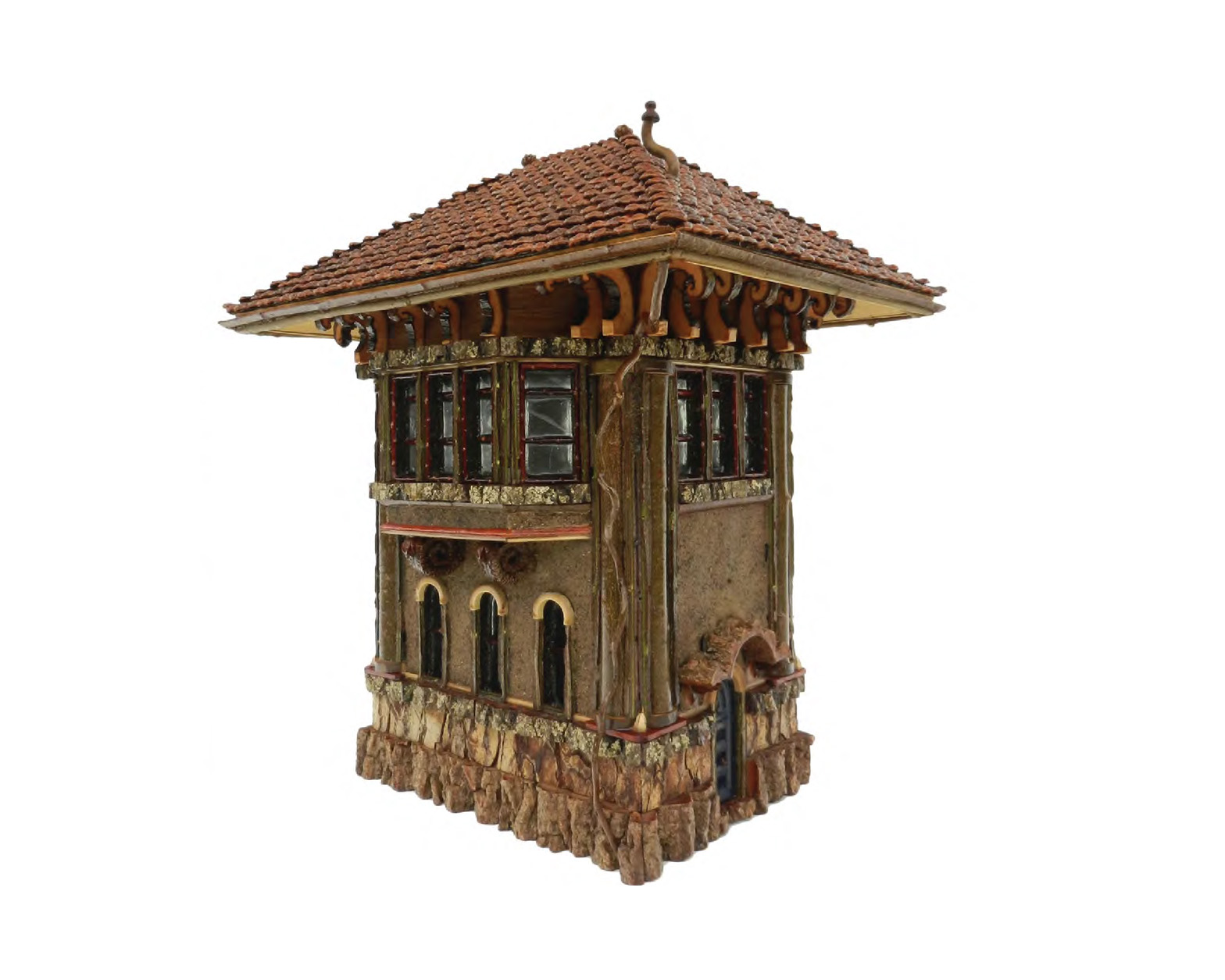
Mattes Street Signal Tower
Scranton, Pennsylvania
Steamtown National Historic Site, Pennsylvania
The Mattes Street Signal Tower controlled rail traffic in front of the Scranton passenger station at the eastern end of the yards. The tower was representative of the D, L & W’s standardized signal tower design of 1908-1915. Steamtown NHS occupies about 40 acres of the Scranton railroad yard of the former Delaware, Lackawanna and Western Railroad, one of the earliest rail lines in Northeastern Pennsylvania. At the heart of the park is the large collection of standard-gauge steam locomotives and freight and passenger cars that New England seafood processor F. Nelson Blount assembled in the 1950s and 1960s.
Botanical Materials:
Facade: grout
Roof: pine cone scale, acorn cap, Harry Lauder’s walking stick
Door: kiwi vine, leaf
Window: winged euonymous, bamboo, salt cedar
Foundation: ash bark, elm bark
Corner Trim: Harry Lauder’s walking stick, winged euonymous
Bay Supports: ram’s horn Corbels: hollow branch
Gutter: Harry Lauder’s walking stick
Theodore Roosevelt Home
Sagamore Hill National Historic Site, New York
Sagamore Hill was the home of Theodore Roosevelt, 26th President of the United States, from 1885 until his death in 1919. During Roosevelt’s time in office, his “Summer White House” was the focus of international attention. Its 83 acres of forested areas, meadows, salt marsh, and beach are home to birds, small mammals, turtles, frogs, and insects.
Botanical Materials:
Roof: elm bark
Siding: turkey tail fungus
Foundation: pine bark
Shutters: oak bark slices
Windows: birch stick, cloves, Australian pine fruit
Driveway pediment: pine cone scales
Ornamentation: royal Poinciana seed, clove, Australian pine fruit, date vine
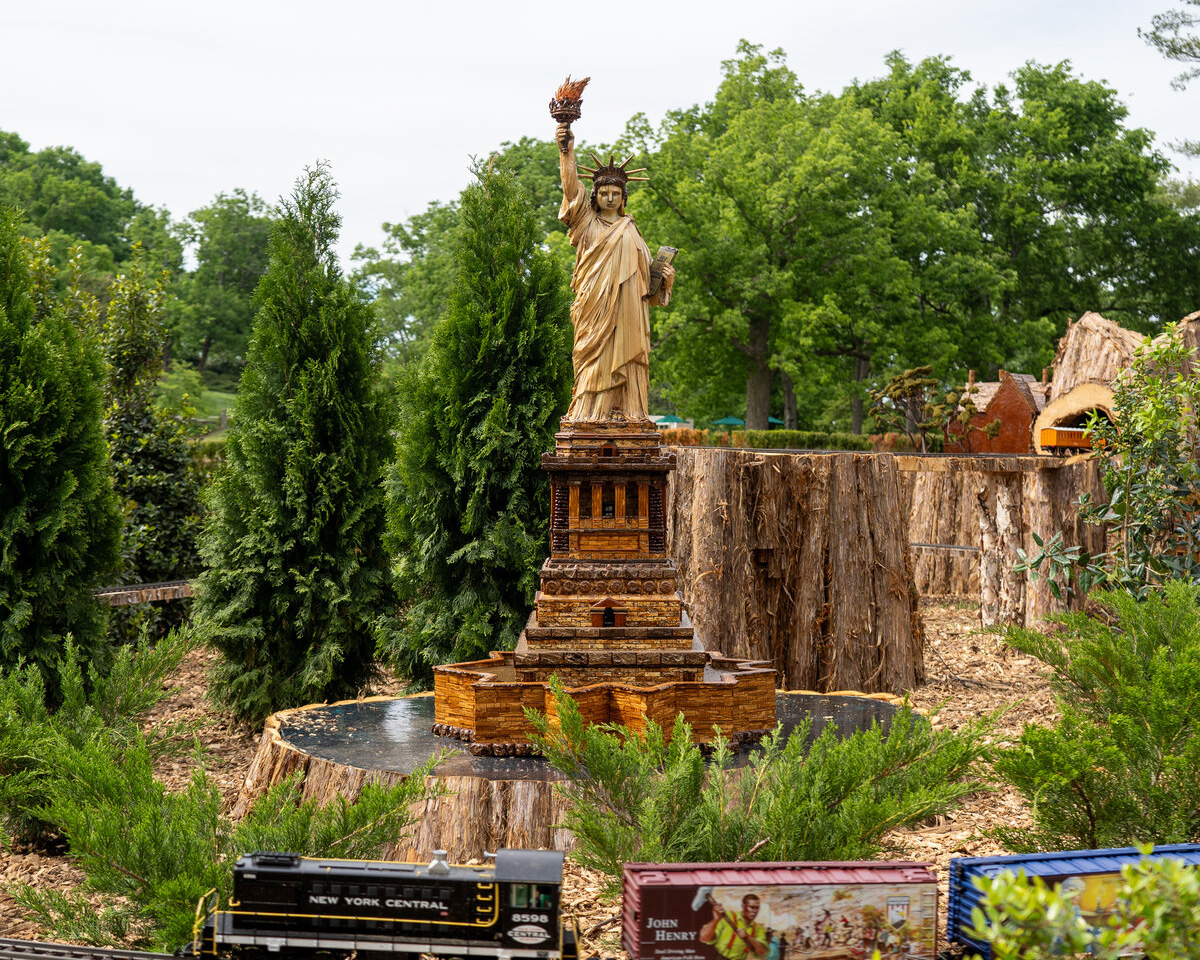
Statue of Liberty
New York Harbor, New York
Sponsored by Anonymous
On loan from the New York Botanical Garden.
A gift of friendship from France to the United States, the massive copper statue has served as a symbol of democracy and freedom. The Statue of Liberty was dedicated on October 28, 1886. It was designated as a National Monument in 1924. When European immigrants came to Ellis Island in the late 1800s to early 1900s, they were first greeted by this icon of freedom looking over them. The designer was Auguste Bartholdi, who also designed the Fountain of Light and Water now in Bartholdi Park at the U.S. Botanic Garden.
Botanical Materials:
Crown: bamboo, palm paddles
Face: tobacco leaf, lotus seed, acorn cap, mahogany pod, pintado heart
Torch: bamboo, coconut hull, walnuts, acorn cap
Ornamentation: walnut shell, alder pod, acorn cap
Fingers: hickory shell
Arms: driftwood
Robe: palm fiber, palm stem
Feet: driftwood, pine cone scales
Base: elm bark, bamboo, walnut hull, pistachio shell, eucalyptus pod, grout, pine cone scales
Columns: cinnamon stick, palm stem, mahogany pod
Earth Lodge Dwelling
Knife River Indian Villages National Historic Site, North Dakota
Dome-shaped homes built by American Indian women to shelter themselves and their extended families. An earth lodge would be between 30 and 60 feet in diameter, 10 to 15 feet high, and took approximately 7 to 10 days to complete from start to finish. The women rebuilt the earth lodges approximately every 10 years. An earth lodge housed between 10 and 20 people, usually sisters and their families. Beds were located around the outer ring in the areas between support poles. Personal items were kept under the beds while general use items were kept on raised platforms similar to bed frames. A typical earth lodge also contained a corral for prized war and hunting ponies on one side of the door.
Botanical Materials:
Roof: gourd, mosses, shelf fungus
Facade: moss, grasses
Door: leaves
Ornamentation: birch bark, driftwood, black walnut bark, acorn caps, palm fiber, forsythia sticks, screw pods, Indian paint brush, sycamore sticks, Harry Lauder’s walking sticks, seed pods, rice
Old Faithful Inn
Yellowstone, Wyoming
Yellowstone National Park
Sponsored by Duncan & Olivia McKinney
Construction for The Old Faithfull Inn, named for the nearby geyser, began in 1903. Yellowstone National Park’s hotel exemplifies the use of rustic architecture at a large scale to complement a natural landscape. The rhyolite that formed Yellowstone’s caldera during volcanic upheavals provided the stone for the building’s foundation, and local lodgepole pine the logs for its walls. Skilled craftsmen embellished the windows and stairways with gnarled wood selected for its inherent beauty. As designed by architect Robert Reamer, the inn combines rugged materials and organic motifs in a way that expresses both frontier sensibilities and elegance.
Botanical Materials (front):
Chimney: honeysuckle
Lookout Flagpole: honeysuckle
Lookout Flags: oak, ruscus leaves, lemon leaves
Lookout Railings: grape vine, Harry Lauder’s walking stick, twigs
Porch Columns: wisteria vines
Porch Decking: cedar wood
Porch Rails: grape vine
Porch Beams: grape vine
Doorstep: shelf fungus
Corbels: contorted witch hazel Roof
Ridge: winged eponymous
Roof Shingles: cedar bark
Smaller Columns: grape vine
Botanical Materials (back):
Ceiling: salt cedar sticks
Walls: cedar bark
Windows: winged euonymous
Floors: sliced cedar
Fireplace: pine bark
Ornamentation: willow, birch sticks, slate, Harry Lauder’s walking sticks, eucalyptus pods, acorn caps, grape vine, birch bark, leaf gall, lichens, reindeer moss
Cliff Dwellings
Mesa Verde, Colorado
Mesa Verde National Park
The cliff dwellings of Mesa Verde are some of the most notable and best preserved in the North American Continent. Sometime during the late 1190s, after primarily living on the mesa top for 600 years, many Ancestral Pueblo people began living in pueblos they built beneath the overhanging cliffs. The structures ranged in size from one-room storage units to villages of more than 150 rooms. While still farming the mesa tops, they continued to reside in the alcoves, repairing, remodeling, and constructing new rooms for nearly a century. By the late 1270s, the population began migrating south into present-day New Mexico and Arizona. By 1300, the Ancestral Puebloan occupation of Mesa Verde ended.
Botanical Materials:
Facade: cork bark slices, sand, grout
Ladders: willow
Plants: lichen, reindeer moss, magnolia fruit
Taos Pueblo
Taos, New Mexico
The Taos Pueblo dates back to between 1000 and 1450 C.E. The first Spanish explorers arrived in Northern New Mexico around 1540, believing the Pueblo to be one of the golden cities of Cibola. Constructed entirely of adobe, the Pueblo is many individual homes built side-by-side and in layers, featuring common walls but no connecting doorways. Before there were doors or windows added, entry was gained only from the top. Today the Pueblo is still inhabited, with approximately 150 people living within the Pueblo full time. The buildings that make up the Pueblo are considered to be the oldest continuously inhabited communities in the USA.
Botanical Materials:
Facade: grout, cork
Door/Window Trim: willow
Doors: cedar, palm fiber, locust bark, palm stem
Ladders: birch twigs
Ovens: cork, egg gourds, acorn cap
Chimneys: magnolia stem
Rain Gutters: bamboo
Grand Canyon Railroad Station
Grand Canyon National Park, Arizona
Sponsored by The Landsberg Family
The Grand Canyon Railroad Station was designed by architect Francis Wilson and constructed in 1909-1910. Serving as the introduction to the Grand Canyon, the building set the tone for the visitor experience, evoking a strong sense of place. The last passenger train passed through the station in 1968, with the freight office closing a year later. Today it is a popular photo-op for visitors to the Grand Canyon.
Botanical Materials:
Roof: pine bark
Facade: cedar shingles, black walnut, birch bark
Door: black walnut, cinnamon stick
Foundation: horse chestnut
Ornamentation: cedar, beech bark, birch sticks, eucalyptus pod, grape vine, palm
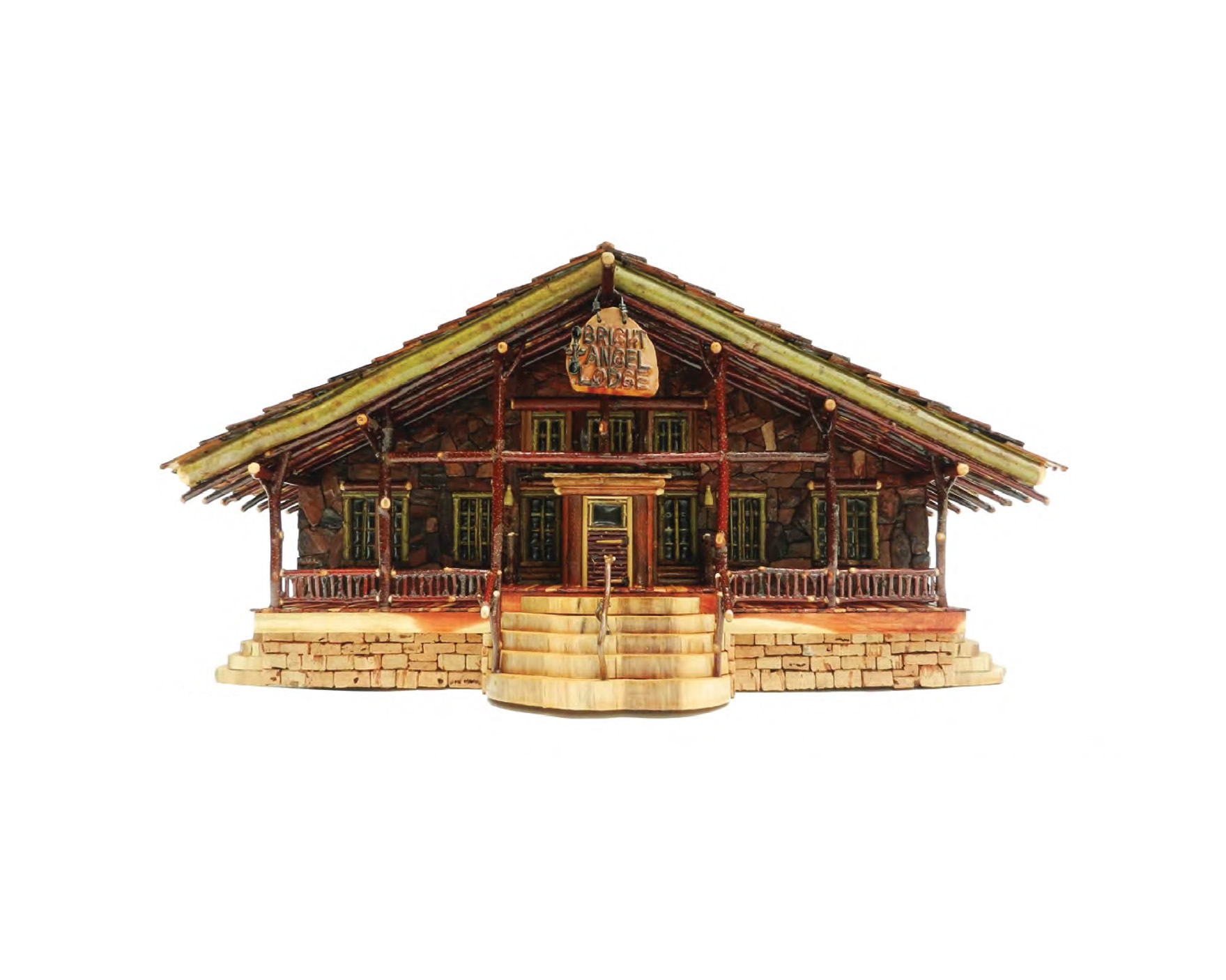
Bright Angel Lodge
Grand Canyon, Arizona
Grand Canyon Village Historic District
The Grand Canyon hotel, Bright Angel Lodge, was dedicated on June 22, 1935. Its mission was to provide moderately priced accommodation for tourists with moderate incomes. Inside the hotel lounge, Mary Colter designed the now famous 10-foot-high fireplace, representing the layers of rock inside the canyon. The top is constructed of Kaibab Limestone, which is found on the rim of the canyon. The base is constructed of smooth river stones from the bottom of the canyon. Grand Canyon Village Historic District comprises the historic center of Grand Canyon Village, on the South Rim of the Grand Canyon in Grand Canyon National Park, Arizona. The district includes numerous landmark park structures, many of which are National Historic Landmarks themselves, or are listed on the National Register of Historic Places. The town design as a whole is also significant for its attention to integration with the Grand Canyon landscape and its incorporation of National Park Service Rustic design elements.
Botanical Materials:
Facade: pine bark
Roof: cedar bark Door: salt cedar, reed, winged euonymous
Window: winged euonymous
Foundation: cork bark
Chimney: pine bark, acorn caps
Steps: cedar
Railing: salt cedar
Porch: cedar, willow
The Alamo
San Antonio, Texas
Sponsored by Aquarius Farms
Once a mission, The Alamo became a symbol of Texas’ drive for independence. The San Antonio Mission was established in 1718, and the now-famous building was built in 1758. It was made to be defendable from raids, and in 1836, pro-Texas soldiers held out for several days against the Mexican Army from within the mission’s walls. Famous men like James Bowie and Davy Crockett were killed in the siege.
Botanical Materials:
Facade: grout, pine bark
Curved Roof: sala leaf, bamboo
Front Door: cinnamon stick, eucalyptus pod, black walnut bark
Window Trim: reed, bamboo, winged euonymous
Niches: arborvitae, pine cone scale, Australian pine fruit
Columns: mahogany pod, magnolia fruit stem, acorn cap, dusty miller
Ornamentation: peach pit, dawn redwood cone
Dr. King’s Birth Home
Atlanta, Georgia
Sponsored by Aquarius Farms
The house in which Martin Luther King, Jr. grew up, as well as Ebenezer Baptist Church where he and his father preached, are preserved on the 22-acre Martin Luther King Jr. National Historic Site. Also on the site are Freedom Hall, a museum on worldwide struggles for freedom, and the grave sites of Martin Luther King, Jr. and Coretta Scott King.
Botanical Materials:
Roof: white pine bark
Facade: birch bark, grout
Foundation: zelkova bark, red grout
Chimney: driftwood
Ornamentation: black bamboo, sliced walnut hull, salt cedar, winged euonymous, bur oak cap, palm leaf stem, turkey tail fungus, mahogany pod hull
Maggie Lena Walker House
Richmond, Virginia
Maggie L. Walker National Historic Site
Home of an African American woman who devoted her life to Civil Rights advancement in Jim Crow-era Virgina. As a bank president, newspaper editor, and fraternal leader, Walker served as an inspiration of pride and progress. Today, Walker’s home is preserved as a tribute to her enduring legacy of vision, courage, and determination.
Botanical Materials:
Facade: grout
Door: locust bark
Windows: forsythia stem, hickory hull, Japanese snowbell pod
Steps: mahogany hulls, grape vine
Porch Roof: magnolia leaves
Porch Roof Trim: cloves, banana stem, date vine, hickory shell
Corbels: bur oak cap, beechnut
Roof Railing: bamboo, Australian pine fruit
Roof Peak Detail: mahogany pods, poppy pods, eucalyptus pod, sliced peach pit, tulip poplar stem, pine cone scales
Graceland
Memphis, Tennessee
Elvis Presley’s Tennessee home.
The Ryman Auditorium
Nashville, Tennessee
Sponsored by GSRM Law
Music City’s “Mother Church” and world-renowned concert hall.
Little Greenbrier School
Great Smoky Mountains National Park, Tennessee
Late 1800s school, church, and community gathering spot in the Great Smoky Mountains.
Cable Mill
Great Smoky Mountains National Park, Tennessee
The Mill in Great Smoky Mountains National Park showcases typical Appalachian-style construction.
John Oliver Cabin
Great Smoky Mountains National Park, Tennessee
Early 1800s home of the first permanent European settlers to this area of the Great Smoky Mountains.