

Exposition of Elegance Classic Cars – Lot B
Vintage Era (1919–1929)
One of only 12 remaining 1919 Sunbeam 24hp cars, this example was shipped new to Chile, where it was owned by the son-in-law of the British ambassador. After he was killed in a hunting accident in the early 1920s, the car remained with his widow, who stored it in a carriage house until it was sold in an estate sale after her death in 1974. An American buyer had it shipped to the US, where it was recommissioned. It was then acquired by Bruce Dowell, a well-known British automotive historian and Sunbeam aficionado, and repatriated to the UK. The current owner purchased it in London and brought it back to the US in 2024.
Light and powered by a 4.5-liter inline-six, the car was quick for its time. It has rear brakes only; the foot brake operates a prop shaft brake rather than the wheel drums, which are controlled by the hand brake—making stopping from speed less effective. The leather is largely original and, aside from an older repaint, the car remains highly original.
This Rolls-Royce Silver Ghost 17TG was completed as a finished chassis on March 22, 1923. With nickel fittings, an Alpine Eagle engine (number P119), and “D” rake steering suitable for owner driving, the Speed-type chassis was delivered by train to the coachbuilder, Offord & Sons Ltd., who constructed an elegant Coupé body with a double dickey seat. The completed car was delivered to Henry M. Lorden of Ravenswood, London, son of Sir John Lorden, proprietor of the Aerated Bread Company.
Extensively restored in 2014–15, the car was rebodied with the current wide torpedo touring coachwork by A.J. Glew and P & A Wood of England. Discovered in Amsterdam by Crispin Menefee, the Menefees acquired the 17TG, affectionately known as “Pearl,” and have since toured widely with the 20 Ghost Club, the Silver Ghost Association, and regional touring groups in the U.S. This Silver Ghost retains its original 7.4 liter inline-six engine, 4 speed transmission, and period correct rear wheel drive—an enduring example of Rolls Royce craftsmanship and touring heritage.
Owned by John & Crispin Menefee
A 1920s Bentley represents the pinnacle of early British motoring. An elegant fusion of power, craftsmanship, and endurance—it embodies the height of the marque’s performance. This example is a 1925 Bentley 3 Litre, a model that formed the technical foundation for Bentley’s later 6 cylinder cars, including the Speed Six, which became Bentley’s most successful racing model.
Its 3.0-liter, 4-cylinder engine featured an overhead camshaft, four valves per cylinder, dual carburetors, and dual ignition. The 3 Litre famously won the 24 Hours of Le Mans in 1924 and was one of the fastest and most advanced production cars of its time. Even beyond the track, it was prized by wealthy motorists for long-distance touring—capable of sustained high speeds with a level of comfort unusual for the period.
This car retains its original Vanden Plas Sports Tourer body. It was exported to South Africa in 1947, later brought to the United States in 1996, and has been owned by the Porter family for the last 30 years. It has participated in numerous races, hill climbs, rallies, tours—and is still driven often.
Owned by Gregory Porter
A distinguished example of Packard’s pre-war craftsmanship, this Sport Phaeton represents a rare piece of automotive history. This car was originally purchased by Fred Krug from Berry Motors in St. Louis. He drove it until 1934, when it was retired to a barn in western St. Louis County after his wife refused to endure another winter in an open car. In response, he replaced it with a closed Packard sedan.
The car remained undisturbed in that same barn until 1963, when it was discovered and purchased for $1,000 by the current owner’s grandfather. It has remained in the family, passed down through three generations. Now approaching its centennial and showing just 63,000 original miles, it stands as a testament to Packard’s renowned craftsmanship—aptly captured in the company’s famous slogan: “Ask the Man Who Owns One.” Its blend of elegance, engineering excellence, and continuous family ownership makes it not just a car, but a living legacy still admired today.
Owned by Amy & David Nau
Pre-War Era (1930–1945)
A striking example of custom coachbuilt luxury, this 1930 Lincoln Model L Sport Roadster by Locke & Company reflects the elegance and craftsmanship of the Classic Era. Originally displayed at the prestigious 1930 Chicago Auto Show, it was a rare gem even in its heyday, with only 15 examples produced. This car is believed to be the oldest surviving example among just four remaining Locke Sport Roadsters. Combining Lincoln’s engineering excellence with Locke’s distinguished coachbuilding, this bespoke roadster exudes sophistication and style.
Acquired in 1978 by Gene Nau, the car was subsequently restored by his father, Jerry. Nearly five decades later, it remains a cherished family heirloom, now enjoyed by the third and fourth generations. Each generation has contributed to its careful preservation, ensuring its legacy endures. From the 1930s to the modern day, this Lincoln Model L Sport Roadster stands as a lasting symbol of an era defined by innovation and timeless design.
Owned by Amy & David Nau
The 1931 Studebaker President epitomized automotive elegance during the Golden Age of classic cars. Boasting a sleek and aerodynamic design, its long hood and flowing fenders exuded a timeless sophistication. The Studebaker President featured distinctive chrome accents, including a prominent radiator grille and artfully crafted headlights that added a touch of opulence. Under the hood, a robust inline-eight engine provided formidable power, delivering a smooth and refined driving experience.
Inside, the luxurious cabin showcased fine craftsmanship with plush upholstery and attention to detail. The dashboard boasted a symphony of gauges, embodying the era’s commitment to both style and functionality. As a symbol of prestige, the 1931 Studebaker President represented the pinnacle of automotive engineering, capturing the imagination of enthusiasts and standing as a testament to the elegance and innovation of its time.
Owned By Craig Pearson
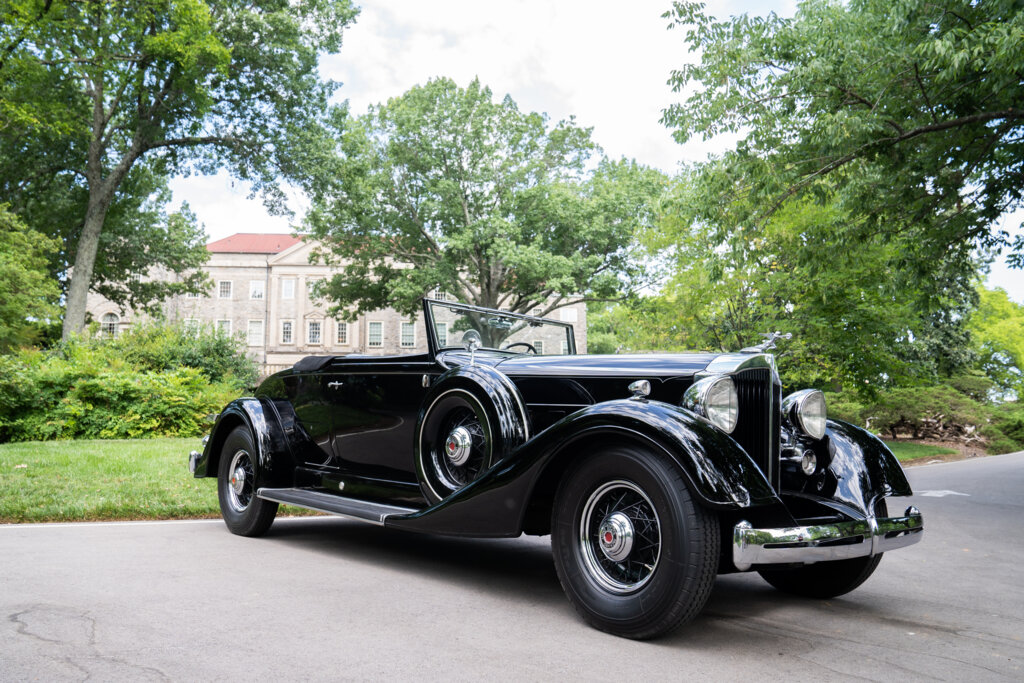
The 1934 Packard Super Eight Victoria epitomizes the elegance and luxury of its era, showcasing the timeless design that made Packard a symbol of automotive opulence. With its graceful lines and sculpted fenders, the Victoria exudes sophistication, capturing the essence of Art Deco aesthetics prevalent in the 1930s. The long hood houses a powerful 8-cylinder engine, delivering a smooth and commanding performance on the open road.
The distinct grille and flowing curves of the bodywork create a harmonious blend of form and function. The interior boasts sumptuous upholstery and meticulous attention to detail, offering a plush and comfortable experience for its occupants. As a symbol of pre-war automotive excellence, the 1934 Packard Super Eight Victoria remains a prized collector’s gem, embodying the glamour and craftsmanship of a bygone era.
Owned By Martin McNamara
The 1935 Ford Model 50 half-ton pickup truck was a vital workhorse in Depression-era America, serving farmers, tradespeople, and small business owners who relied on dependable transportation to survive and rebuild. Painted in stately Dearborn Blue with a no-frills black interior, this pickup combined form and function.
Under the hood, its 221-cubic-inch flathead V8 engine—the first of its kind in an affordable pickup—offered unprecedented torque and reliability for hauling goods, tools, or produce. Its rugged steel bed and sturdy frame allowed it to traverse rough terrain and unpaved roads, extending economic reach to remote communities. More than just a vehicle, the Model 50 became a symbol of American resilience, helping families transport essentials, workers move between jobs, and local commerce regain its footing. In its time, it was not just helpful; it was indispensable.
Owned By Dave Conway
The 1938 Ford Model 48 Woodie stands as an iconic symbol of American automotive craftsmanship, blending vintage elegance with practical utility. As part of the woodie car lineage, it embodies a unique era when cars were adorned with wooden body panels, reflecting a fusion of style and function. Constructed atop Ford’s sturdy Model 48 platform, this woodie exudes timeless charm with its meticulously crafted wooden panels, evoking nostalgia for a bygone era.
Under the hood, the Model 48 is powered by a robust V8 engine, delivering impressive performance for its time. With its smooth handling and reliable power, it offers a delightful driving experience on both city streets and country roads. Beyond its mechanical prowess, the woodie’s spacious interior and flexible seating arrangement make it ideal for family outings or leisurely drives. The 1938 Ford Model 48 Woodie represents a blend of history and performance, captivating enthusiasts and collectors alike with its enduring appeal.
Owned By Greg Mashburn
The Packard Motor Car Company operated from 1899 until 1958. From its founding through the 1930s, it focused on the ultra-luxury market, building what many consider “the American Rolls-Royce.” The marque developed a loyal following, competing with European makers like Bentley and Mercedes-Benz. Packard was popular among Hollywood personalities and counted Bob Hope, Clark Gable, and Judy Garland as regular customers. It was also the preferred motor car of Franklin Roosevelt, and Japan’s Emperor Hirohito owned 10!
This 1938 Twelve (named for its 12-cylinder engine) was Packard’s top-of-the-line personal luxury car. These cars were largely hand-built, and each was individually track-tested at the Packard Proving Grounds before delivery to the ordering customer. This particular car, chassis #11392020, was delivered new through Packard’s dealer in Beverly Hills, and spent most of its life in California. Only 78 Coupe Roadsters were manufactured, and only a handful remain today. Finished in Chinese Red with a coordinating red leather interior, it benefits from a Concours-level restoration and is considered one of the finest examples in existence.
Owned By Barry Stowe
This 1940 Packard Super Eight 180 Convertible Victoria by Darrin in Laguna Maroon was originally sold by E. Gray Smith’s dealership to Miss Catherine Tyne in Nashville. The car was equipped with a 160-horsepower, inline-eight engine and coachwork by the Hollywood builder, Dutch Darrin. In 1949, Miss Tyne married Mr. Edward Potter, who firmly suggested that she sell the car, which she did to an employee of Belle Meade Country Club. That owner then sold it to Mr. Frank Waterhouse who subsequently moved to California, taking the car with him.
Mr. Waterhouse apparently didn’t like the maroon paint, so he commissioned Dutch Darrin, the original coachwork builder of the car, to repaint it in California Cream and update it with a more aesthetically pleasing dash from a 1938 Packard V12 limousine. Other modifications include the dual carburetor intake manifold system and various body stiffening struts.
This car was acquired by the present owner in 2022. He is the great-nephew of the original owner, Catherine Tyne Potter!
Owned By John & Crispin Menefee
The 1941 Cadillac Series 62 Sedan Convertible exudes timeless elegance. This classic automobile, a symbol of luxury from a bygone era, boasts a sleek and aerodynamic design, featuring sweeping lines and a graceful profile. The convertible top, meticulously crafted to perfection, effortlessly retracts to reveal a sumptuous interior adorned with opulent materials. The Central Valley Green Metallic hue adds a touch of sophistication, accentuating the car’s dignified presence on the open road.
Under the hood, the 1941 Cadillac Series 62 is powered by a formidable engine, delivering a smooth and powerful driving experience. Its attention to detail extends to the interior, where plush seating, polished wooden accents, and intricate instrument panels create an atmosphere of refined comfort. This automotive masterpiece captures the essence of the time, representing a pinnacle of craftsmanship and style in the vintage car realm.
Owned By John & Crispin Menefee
Positioned just below the flagship 180 in Packard’s Senior Series, the 1941 Packard 160 Convertible shared many premium features with its top-tier counterpart. Power came from a robust 356-cubic-inch inline-eight engine with nine main bearings, producing 160 horsepower. Introduced to replace Packard’s retired V12, this renowned engine—widely considered the company’s finest—remained in production from 1940 to 1951 and ran so smoothly a nickel could be balanced on edge atop its idling block. Paired with a 3-speed manual transmission and optional Borg-Warner overdrive, this powerplant made cruising at 65+ mph possible.
This example is #100 of approximately 199 Super Eight Convertible Coupes produced. Its long hood, tombstone grille, flowing fenders, and waterfall-style side grilles give it unmistakable presence, while the convertible top invites open-air touring. Notable features include dual side-mounted spare tires, power convertible top, radio, under-seat heater, vacuum-assisted brakes, and front and rear bumper guards. The 1941-42 model years marked the end of Packard’s most opulent era before the company shifted focus to engine production for World War II.
Owned By Danyell & Brian Dudney
Post-War Era (1946–1959)
Though Chrysler did not invent the iconic American “Woody,” it can be argued that the brand arguably perfected it with the Town & Country. This top-tier luxury vehicle combined the refined New Yorker series from the windscreen forward with an artfully crafted wooden body behind it. The name is credited to Paul Hafer of Pennsylvania’s Boyertown Body Works, who suggested the car looked “Town from the front and Country from the rear.” Costly to build and buy—priced about 25 percent higher than a 1947 Cadillac Sedan—it required specialized maintenance, including recommendation that the wood be refinished every six months. Still, its success carried production through 1948.
Because the Town & Country was a “Halo” model, meaning it was designed to draw people into showrooms who would ultimately purchase something more practical, only 2,600 of these were manufactured, and few remain due to the difficulties involved in maintaining the extensive woodwork. Finished in Catalina Tan with a red leather/Bedford cord interior, this National award-winning car is one of the finest examples in existence with an extraordinary restoration of the original wood trim.
Owned By Barry Stowe
The 1949 Bentley Mark VI exudes timeless elegance, showcasing the classic design and craftsmanship synonymous with Bentley’s legacy. Its sleek, flowing lines seamlessly merge with the distinguished grille, embodying a refined aesthetic that defines the post-war era. The Mark VI is powered by a robust inline-six engine, delivering a harmonious balance of performance and sophistication.
The spacious interior, adorned with luxurious materials, reflects an era when attention to detail was paramount. With its distinctive dual-tone paintwork and chrome accents, the Bentley Mark VI stands as a symbol of opulence and automotive artistry. Whether cruising through city streets or embarking on a grand tour, this vintage masterpiece captures the essence of a bygone era, where automotive excellence met unparalleled style. The 1949 Bentley Mark VI remains a testament to the enduring allure of classic luxury automobiles.
Owned By Walt Bentley
*Late Cancellation
The 1950 Oldsmobile Model 88 Holiday 2-Door Coupe was a groundbreaking vehicle, blending style and performance in the emerging post-war automotive era. As one of the first hardtop coupes, it featured a sleek, pillarless design that gave it a sporty and upscale look. This example is finished in a deep black exterior, accentuating its smooth lines, chrome trim, and signature rocket-inspired hood ornament. The wraparound windshield and gently sloping roofline added to its streamlined appeal.
Inside, the blue and gray cloth interior provides a stylish contrast to the dark exterior, offering a comfortable and elegant driving experience. The dashboard showcases Oldsmobile’s signature speedometer and chrome-accented controls, reflecting the era’s attention to detail. Under the hood, the legendary 303-cubic-inch Rocket V8 engine delivers strong performance, paired with a Hydra-Matic automatic transmission. The 1950 Oldsmobile 88 Holiday Coupe remains an icon of early American muscle and design innovation.
Owned By Agnes & Jim Peterson
A rare survivor, this 1952 Buick Super is an example of American post-war automotive design in original condition, with few changes. Exhibiting the best features of a time when America produced more cars than any other nation, this Buick reflects the hopes of a country putting World War II rapidly behind them.
Harley Earl, the design genius of General Motors, influenced 1952 Buicks. Many design features of this Buick Super can be tracked to Earl’s 1938 concept car, the Y-Job, including wrap-around bumpers, dropped fender lines, and the proportions of hood versus trunk. Purchased in Wisconsin in the fall of 1951 by a college professor for just under $3,000, the car stayed in his family for two generations with low mileage. By the 1980s, it was sold, then rapidly sold again. The fourth owner retained the car for a number of years before selling it in 2013 to the present owner, Jerry Trescott of Franklin, TN. Garage kept from day one, the car has just over 44,000 miles, preserving a beautiful example of American design.
Owned By Beth & Jerry Trescott
The 1953 Chevrolet 3100 Good Humor Ice Cream Truck is a nostalgic embodiment of the American ice cream experience. This vintage beauty showcases the iconic Good Humor brand, known for its quality frozen treats since its inception in 1920. The truck’s exterior boasts the classic Good Humor livery, featuring the smiling “Ice Cream Man” logo, creating an irresistible allure for customers of all ages.
With its chrome accents, rounded curves, and vibrant colors, the truck exudes charm reminiscent of a bygone era. The Good Humor company, founded by Harry Burt, pioneered the mobile ice cream vendor concept, delivering joy to neighborhoods across the nation. This Chevrolet 3100 serves as a mobile time capsule, transporting enthusiasts back to a simpler time when the familiar chimes of the ice cream truck signaled the arrival of sweet, frozen delights on warm summer days.
Owned By Deb & Barry Fodor
This 1953 MG TD is a classic example of the British sports cars that captured American enthusiasm in the post-war era. Finished in British Racing Green with a black interior, this open-top roadster embodies the charm and driving experience that made MGs so popular in the U.S. Returning American servicemen, who had encountered nimble European sports cars during World War II, helped fuel demand for lightweight, fun-to-drive vehicles like the TD.
MG capitalized on this interest by exporting thousands of cars to the U.S., introducing Americans to the joys of precision handling and responsive performance. The TD featured a 1.3L XPAG inline-four engine, rack-and-pinion steering, and independent front suspension—advancements that set it apart from many domestic cars of the time. Its sweeping fenders, and classic grille gave it undeniable British character, making it a beloved part of America’s early sports car culture.
Owned By Craig Abington
The 1954 Jaguar XK120 M epitomizes post-war automotive elegance, boasting a sleek design and unparalleled performance. Finished in a timeless Old English Cream, its allure is matched only by the opulence of its Red Connolly hides. Beneath its hood lies a potent inline-six engine, a marvel of engineering, delivering exhilarating acceleration and a top speed that solidifies its status as a sports car legend.
Post-war, the Jaguar XK120 M became an icon of British automotive prowess, captivating enthusiasts worldwide with its combination of style and speed. Its racing pedigree further enhanced its reputation, dominating tracks across Europe and America, including victories at Le Mans and other prestigious competitions. Beyond its triumphs on the race circuit, the XK120 M became a symbol of post-war optimism, embodying the spirit of innovation and craftsmanship that defined the era.
Owned By Ivy & John Anderson
This 1955 Austin Healey 100M exudes timeless elegance with its stunning white exterior, capturing the essence of vintage automotive sophistication. This classic sports car, renowned for its iconic design, boasts a graceful silhouette that perfectly complements its powerful performance. The lustrous white paint enhances the car’s allure, emphasizing its curves and distinctive features.
The Austin Healey 100M is a symbol of mid-century automotive craftsmanship, featuring sleek lines and a distinctive grille that define its era. Its open-top design invites the wind to caress the faces of enthusiasts lucky enough to experience the thrill of driving this iconic machine. Beyond its aesthetic charm, the 100M is celebrated for its remarkable engineering, delivering an exhilarating ride that encapsulates the spirit of an era when driving was a celebration of freedom and style.
Owned By Mike Cronin
The 1955 Chevrolet Bel Air, famously marketed as the “Hot One,” launched the legendary “Tri-Five” era of full-size Chevrolet passenger cars. These vehicles are considered icons of 1950s American automotive design and culture, largely due to their modern styling, the debut of Chevy’s small-block V8 engine, and their lasting popularity with hot-rodders.
This 1955 Chevy Bel Air on display is a fully restored and modernized showpiece. Beneath its classic exterior, a 383 Stroker crate engine with EFI delivers powerful, reliable performance, supported by a Precision Hot Rod Fabrication frame and chassis for a smooth, confident ride. Inside, a custom leather interior blends craftsmanship with comfort. This standout build has earned honors at some of the country’s most prestigious events, including the Tri-Five Nationals, Goodguys Nationals, and the Triple Crown of Rodding—cementing its status as both a tribute to the original and a premier modern classic.
Owned By DK & Mark Buford
The 1955 Ford Crown Victoria is a standout symbol of mid-century American automotive style. Introduced as part of Ford’s upscale Fairlane line, it’s best known for its distinctive chrome “basket-handle” roof band that arches over the hardtop—an instantly recognizable design flourish that set it apart from other cars of the era. The Crown Victoria—including this pristine example in Regency Purple Metallic & Snowshoe White—featured bold two-tone paint schemes, wraparound windshields, and generous chrome, capturing the optimism and flair of the 1950s. Its unique chrome crown over the roof was available only in 1955 and 1956, while swept-back chrome accents around the headlights give the impression of eyelashes.
Under the hood, buyers could choose Ford’s reliable Y block V8, offering smooth performance to match the car’s confident presence. While never the highest-volume seller, the Crown Victoria made a lasting impression. Today, it’s prized by collectors as a beautifully preserved snapshot of post-war American car culture when style and spectacle were as important as horsepower.
Owned By Terry & Mike Esterday
The first year of the Thunderbird marked Ford’s iconic vision of 1950s American automotive design when the two-seat convertible reached showrooms in October 1954 as a 1955 model. It was the first two-seat Ford produced since 1938 and was developed in direct response to Chevrolet’s Corvette, unveiled at the at the 1953 New York Auto Show. This remained the only two-seat convertible Thunderbird until the 11th generation was unveiled in 2002.
Marketed by Ford as a “Personal Car of Distinction,” the Thunderbird helped define the emerging personal luxury car segment in the United States. Powered by a standard V8 producing approximately 190 horsepower, the Thunderbird proved well suited to American tastes. Priced at $2,944, Ford sold 16,155 Thunderbirds in 1955, compared to Chevrolet’s 674 Corvettes.
A rare domestic classic for its time, this particular Thunderbird was built early in the model year, in December 1954, and features unique period-correct options, such as automatic transmission, power steering, power brakes, 2-way power seats, a telescopic steering wheel, full wheel covers, and an engine dress-up kit.
Owned By Linda & Ken Tarkington
This 1955 Studebaker President is a sleek and stylish full-size automobile that embodies the bold design and engineering advancements of the mid-1950s. Featuring a distinctive grille, prominent chrome accents, and a streamlined body, it stands out on the road with its elegant yet aggressive stance.
Powered by a robust 259-cubic-inch V8 engine, the President delivers strong performance and smooth acceleration. Its three-speed automatic transmission provides a refined driving experience, while the advanced suspension ensures a comfortable ride.
Inside, the cabin offers premium materials, spacious seating, and a dashboard layout designed for both function and sophistication. Modern for its time, it offered features such as power steering and optional air conditioning, enhancing comfort and convenience.
The 1955 Studebaker President remains a symbol of American automotive innovation, combining performance, luxury, and distinctive styling in a package that continues to capture the admiration of classic car enthusiasts.
Owned By Craig Pearson
The 1956 Chevrolet 210 Series post coupe with Del Ray option is as much a story of devotion as it is of design. This car has been with its current owner twice in a lifetime. It first found its way to Joe Bradshaw more than half a century ago, when he purchased it from his sister at age 21. A decade later, the car was sold to a friend, who kept the car for 37 years until ultimately selling the car back to Bradshaw—still wearing the same character, down to its floor mats.
Restored as a true labor of love, this 1956 Chevy 210 now carries a 265 cubic-inch V8 (originally it had a 6-cylinder), paired with its classic 3-on-the-tree manual transmission. The 210 series, positioned between the 150 and the Bel Air, offered understated style, while the Del Ray trim added a touch of upscale interior refinement. With its signature post body and mid-century lines, this car is more than a restored classic—it’s a lifelong companion, once driven to prom and graduation, and now enjoyed once again on the open road.
Owned By Joe Bradshaw
The 1956 Lincoln Continental Mark II represents the pinnacle of American luxury in the mid 20th century. Produced by Ford’s short-lived Continental Division, it was conceived as a no compromise flagship—designed to rival the finest European luxury cars of the era. Its long hood, restrained proportions, and elegant, fin free lines set it apart from more flamboyant 1950s styling trends, while the signature “continental kit” spare tire bulge became a lasting design icon.
Hand-assembled with exceptional attention to detail, the Continental Coupe featured premium materials throughout and was powered by a smooth, powerful V8 engineered for quiet, effortless cruising. Though expensive and produced in limited numbers, the 1956 Continental achieved its goal: redefining American automotive prestige. Today, it’s celebrated by collectors as a timeless expression of understated elegance, craftsmanship, and post-war luxury ambition.
Owned By John Looney
The 1957 Ford Thunderbird was the final year of Ford’s original two-seat Thunderbird, introduced in the mid-1950s as a stylish response to the rise of American sports cars like Chevrolet’s Corvette. Known for blending performance with comfort, the Thunderbird helped define the personal luxury car segment. Its unmistakable signature includes the iconic porthole windows on the removable hardtop.
While closely related to the 1955 and 1956 models, the 1957 featured refined styling and a longer rear deck, increasing the car’s overall length. A Thunderbird of this era was famously featured in American Graffiti, further cementing its place in American car culture.
This example underwent a full body restoration in 2007–2008 and retains its original color, refreshed with new blue paint, along with an upgraded braking system.
Owned By Tom Vasser
The 1957 Triumph TR3 Small Mouth is a classic British sports car known for its spirited performance and distinctive styling. Produced by the Standard-Triumph Motor Company, the TR3 was introduced in 1955 and became a favorite among driving enthusiasts. The “Small Mouth” designation refers to the earlier version of the TR3, which features a narrow grille compared to the later “Wide Mouth” models introduced in 1958.
Powered by a 1,991cc inline-four engine, the TR3 delivers around 95 horsepower, paired with a four-speed manual transmission, often equipped with an optional overdrive for improved highway cruising. With lightweight body-on-frame construction and front-disc brakes—a rarity for the time—the TR3 offered nimble handling and strong stopping power.
The TR3 Small Mouth is characterized by its cut-down doors, chrome-rimmed headlights, and classic wire wheels. Open-top motoring, combined with its raw, engaging driving experience, makes it a beloved classic among collectors today. In addition, this car has been completely rebuilt; drive train, suspension and brakes with a bare metal repaint and completely new leather interior.
Owned By John Baker
Muscle Car Era (1960–1972)
The 1960 Cadillac Eldorado Seville stands at the height of late-1950s American luxury, defined by sweeping lines, refined chrome, and Cadillac’s signature tailfin silhouette. Part of Cadillac’s top-tier lineup, the Seville coupe paired bold styling with a smooth, V8-powered ride and an emphasis on comfort and prestige.
This example is a true survivor—100 percent original, preserving the character and craftsmanship of its era. No modifications have been made, even down to its original Heather Purple hue, maintaining its factory-correct appearance and authenticity. As one of 1,075 examples built, this car represents a historical finale, marking the last year the Seville coupe body style was produced. Well-preserved and remarkably intact, this Eldorado Seville offers a rare glimpse into Cadillac’s golden age—an enduring expression of design, luxury, and originality from one of America’s most iconic automotive eras.
Owned By Sean Ross
This Mercedes-Benz model is the first in the series of Mercedes luxury cabriolets, exceptionally beautiful cars that were produced through the 1970s. After the success of the famous 300 SL Sports car, Mercedes saw a market for super luxury personal cars. This 1960 model was the first to use fuel injection developed by Robert Bosch.
Distinguished purchasers such as Judy Garland and Marilyn Monroe appreciated the beauty and luxury of the 1958-1960 cabriolets. Also, Prince Rainier III of Monaco bought one for his bride, Grace Kelly. This is a rare car—only 1,112 were made during 1958-1960.
Owned By Susan Looney
The 1962 Chevrolet Corvette, a timeless American classic, epitomizes automotive elegance in its convertible form. Cloaked in the rich allure of Honduras Maroon paint, this iconic sports car captures the essence of sophistication and speed. Its sleek, sculpted body showcases the distinctive dual headlamps and subtle chrome accents, reflecting the design prowess of the era. The convertible top, when lowered, invites the wind to caress its occupants as they embark on open-road adventures.
Beneath the hood lies a potent engine, the heartbeat of this vintage beauty. The 1962 Corvette seamlessly blends performance with style, offering a driving experience that transcends mere transportation. Inside, a cockpit tailored for driving enthusiasts features streamlined controls and a timeless dashboard. This Corvette stands as a testament to an era where automotive craftsmanship reached new heights, leaving an indelible mark on the hearts of enthusiasts and collectors alike.
Owned By Will Cheek
The 1962 Rolls-Royce Silver Cloud II Standard Saloon exudes timeless elegance, epitomizing luxury in automotive design. Originally delivered to Los Angeles, it found its first home with Nethercutt Laboratories, associated with the renowned Merle Norman Cosmetics. This bespoke masterpiece boasts a handcrafted exterior, showcasing the iconic Rolls-Royce radiator grille, sleek lines, and exquisite chrome detailing.
The meticulously preserved interior unveils opulent leather upholstery, polished wood veneers, and meticulous craftsmanship. Powered by a refined V8 engine, the Silver Cloud II offers a smooth and powerful driving experience, complemented by its advanced engineering for its era. As a cherished relic of automotive history, this Rolls-Royce stands as a testament to the brand’s commitment to unparalleled luxury, capturing the spirit of a bygone era with grace and sophistication.
Owned By Brent Elam
The 1963 Morgan Plus 4 SuperSport epitomizes the timeless elegance and sporting spirit characteristics of Morgan Motor Company. Established in 1909, Morgan has been crafting distinct hand-built vehicles, staying true to traditional craftsmanship. The Plus 4 SuperSport, a quintessential British sports car, boasts a sleek design with its low-slung silhouette and distinctively curved wings.
Under the hood, a robust inline-four engine propels this classic beauty, delivering an exhilarating driving experience. The SuperSport model, introduced in the early ’60s, features enhanced performance and refined aesthetics. Its lightweight construction, responsive steering, and precise handling set it apart in the era’s sports car scene.
Beyond its mechanical prowess, the Morgan Plus 4 SuperSport represents a piece of automotive heritage, embodying the enduring legacy of Morgan’s commitment to quality and individuality. With its timeless design and spirited performance, this 1963 gem stands as a testament to Morgan’s enduring influence on the world of classic sports cars.
Owned By Susan & Tom Perkins
The 1963 Studebaker GT Hawk stands as a timeless emblem of automotive elegance, clad in a pristine coat of classic white. This sleek coupe, a product of Studebaker’s design prowess, exudes a harmonious blend of sophistication and performance. The gracefully contoured body lines flow seamlessly, capturing the essence of an era when cars were revered for their distinctive styling. The front grille, adorned with the iconic Studebaker emblem, lends an air of exclusivity to this automotive gem.
Under the hood, the GT Hawk boasts a potent engine, delivering a driving experience that marries power and precision. The interior, adorned with plush seating and chrome accents, beckons occupants into a bygone era of automotive luxury. Riding on distinctive wheels, this 1963 Studebaker GT Hawk not only symbolizes an era of design mastery but also commands attention on the open road, a testament to an enduring legacy of automotive craftsmanship.
Owned By Robert Swope
This meticulously crafted replica pays tribute to the legendary Shelby Cobra of the 1960s, originally conceived by Carroll Shelby. Built in 2023 by the Backdraft Racing factory in South Africa, it embodies both heritage and modern performance with many custom features. Under the hood sits a 427ci Roush engine producing 577 horsepower, paired with 18-inch gloss black knock-off wheels for a commanding stance.
The interior continues the bespoke approach, featuring custom black double-stitched diamond upholstery, a carbon fiber dash, a Sabelt suede steering wheel, and a 4-point Cam Lock harness. Finished in Eminent Pearl White with a blue racing stripe that continues beneath the hood, this car never fails to draw admiration and capture attention wherever it’s displayed.
Owned By Jerry Williams
The 1965 Ford Mustang was the first production year of Ford’s groundbreaking pony car, following its debut in April 1964. Available as a coupe, fastback, or convertible, the Mustang combined sporty styling with affordability, making it an instant classic.
Base models featured a 170-cubic-inch inline-six engine, but buyers could opt for a range of V8s, including the popular 289-cubic-inch engine, which produced up to 271 horsepower in the Hi-Po (K-code) version. Transmission choices included a 3-speed manual, 4-speed manual, or 3-speed automatic.
Distinctive design elements included a long hood, short rear deck, and the iconic galloping pony emblem. The GT package, introduced in 1965, added fog lights, dual exhausts, and special badging. The Mustang also gained optional disc brakes for improved stopping power. With its blend of style, performance, and customization options, the 1965 Mustang set the foundation for a legacy that continues to define American muscle and performance cars.
Owned By Joe Gualtieri
The 1966 Chevrolet Corvette captures the essence of mid-century American performance with timeless Sting Ray styling and refined craftsmanship. Finished in striking Arctic White over a dark blue interior, this example offers a classic and elegant presentation. Powered by a 327-cubic-inch engine paired with a smooth 3-speed automatic transmission, it delivers the spirited performance that defined the Corvette’s reputation. Its original side exhaust adds both authenticity and the unmistakable sound of the era.
Riding on knock-off wheels with whitewall radial tires, the car maintains its period-correct stance and visual appeal, complementing its sleek lines. Inside, an AM/FM radio and optional clock enhance the driving experience with functional detail. Well-equipped and beautifully presented, this 1966 Corvette stands as a true icon—blending power, style, and classic American design.
Owned By Ken Miller
The 1967 Buick Riviera stands as a premier example of a 1960s “gentleman’s muscle car,” blending luxury with innovation. This early model features the distinctive hidden headlights that fold down from within the grille, creating a clean, uninterrupted front profile when closed.
A true luxury sports car, the Riviera pairs sleek, sculpted lines with high-horsepower performance, delivering both presence and power. Finished in the factory color Green Mist Poly with a crisp white interior, it offers a refined and uncommon color combination. Inside, the unusual rolling drum speedometer adds a unique, futuristic touch to the driving experience.
Remarkably, this car remained in one family until its purchase this year (2026) and comes with a detailed book documenting every repair and recorded mileage—an exceptional testament to its history and care.
Owned By Terry & Mike Esterday
Malaise Era (1973–1989)
The 1973 Pontiac Trans Am represents a defining moment in Pontiac’s muscle car legacy. As part of General Motors’ performance brand, Pontiac helped launch the muscle car era in the 1960s, with the Firebird and Trans Am quickly gaining a reputation for power, agility, and race-inspired design. By 1973, the Trans Am reached new heights with the rare Super Duty 455 engine—only 252 produced—and the debut of the iconic “screamin’ chicken” hood graphic, which became synonymous with the brand.
This unique 1973 Trans Am, owned by Amy and Jay DeLuca, is a one-of-a-kind custom build known as “KLRBRD.” Finished in the rare Cameo White exterior with Deluxe White interior, KLRBRD retains its distinctive look while incorporating lightweight carbon fiber components. Its custom 416 cubic inch LS3 engine produces over 550 rear-wheel horsepower, paired with a 6-speed transmission and performance-focused upgrades. While at a glance KLRBRD appears like any other 1973 Trans Am, a closer look reveals subtle customization and performance modifications that honor the enduring spirit of the classic model.
Owned By Amy & Jay DeLuca
Exposition of Elegance Classic Motorcycles – Massey Auditorium
Pre-War Motorcycles (1920s–1930s)
The 1925 Elto Light Twin outboard motor, designed by Ole Evinrude, marked a pivotal advancement in marine propulsion. Elto, short for Evinrude Light Twin Outboard, introduced a lightweight, two-cylinder, two-stroke engine that was more reliable and easier to handle than earlier models. Its compact design and improved performance made boating more accessible to the public, contributing to the growth of recreational boating in the United States. The Elto Light Twin’s success helped reestablish Evinrude’s prominence in the outboard motor industry and laid the groundwork for future innovations in marine engine technology.
Owned By Ken Bratt
In 1928, BMW unveiled the R52, a hallmark of German engineering prowess. Born from BMW’s early history, marked by aircraft engine production during World War I, the R52 embodied precision and innovation. This iconic motorcycle boasts a 494cc flat-twin engine, delivering power and performance ahead of its time. Its distinctive design, featuring a rigid frame and a 1/4 elliptical front fork (last of the flat fuel tank model that identifies the first generations of BMW motorcycles), ensures superior handling and stability on the road. A true masterpiece of vintage engineering, the R52 remains a coveted treasure for enthusiasts worldwide.
Owned By Virginia & David Bloodworth
In a defining moment in motorcycle history, the EL introduced Harley-Davidson’s first overhead-valve V-twin—delivering 40 horsepower from 61 cubic inches (988cc) and setting a new standard for performance. Nicknamed the “Knucklehead” for its distinctive rocker boxes, this engine design became one of the most recognizable in the world. In 1937, Joe Petrali rode a modified EL to 136.183 mph at Daytona Beach—cementing its place in performance history. This motorcycle didn’t just evolve the brand; it was a turning point that helped shape the future of American motorcycling.
Owned By Tom Cleppe
The 1940 Indian Sport Scout introduced the brand’s iconic skirted fenders, blending performance with distinctive styling. Powered by a 45.44-cubic-inch (745cc) side-valve V-twin engine, it offered 22 horsepower and a top speed of 90 mph. The model featured a girder front fork and a rigid rear frame, providing a balance between agility and stability. This iteration of the Sport Scout continued Indian’s legacy in racing, building on its 1937 Daytona 200 victory. This was the first year for Indian’s iconic full fenders, which was the height of the Art Deco styling popularized in the late 1930s.
Owned By Arthur Delor
The 1941 Indian Sport Scout, Model 641, was the final V-twin Scout before World War II halted civilian production. It features a 45.44-cubic-inch (745cc) side-valve V-twin engine producing 22 horsepower, a 3-speed transmission, and a new plunger-style rear suspension for improved comfort. The addition of full skirted fenders and streamlined styling aligned it with the larger Chief model. This model encapsulated Indian’s pre-war engineering and design prowess, marking the end of an era before the company’s post-war challenges.
Owned By Buddy Burnett
Post-War Motorcycles (1940s–1950s)
The 1946 Firestone outboard motor, manufactured by Scott-Atwater, marked Firestone Tire and Rubber Company’s entry into the marine engine market after World War II. This 3.6 horsepower, single-cylinder, two-stroke engine featured a rope-start mechanism and a four-bolt cylinder head, reflecting the resourceful use of pre-war components during a time of material scarcity. Marketed through Firestone’s retail outlets, it made boating more accessible to the public. The collaboration between Firestone and Scott-Atwater exemplified the post-war industrial shift towards consumer goods, contributing to the expansion of recreational boating in America.
Owned By Ken Bratt
The 1947 Harley-Davidson WL is a civilianized version of the famed 45 cubic-inch (750cc) flathead V-twin “WLA” military bike, produced immediately after World War II as a reliable, light, and accessible street motorcycle. Known for its durability and 3-speed, hand-shifted transmission, the 1947 model featured a 4.75:1 compression ratio and iconic springer front suspension, representing the transition from wartime production back to consumer market.
Owned By Jerry Hagar
The 1951 Harley-Davidson Panhead, named for its pan-shaped rocker covers, featured a 74-cubic-inch (1,200cc) V-twin engine with hydraulic valve lifters and aluminum heads for better cooling. While it left the factory as a touring motorcycle, riders in the 1950s and ’60s began customizing Panheads into “choppers”—stripped-down, minimalist bikes with extended forks and custom paint. These early choppers helped define American motorcycle culture and freedom of expression. The ’51 Panhead is revered for its reliability, tunability, and contribution to the post-war custom movement that would shape decades of motorcycle design and counterculture aesthetics.
Owned By Frank Caruti
The 1954 Triumph Tiger T110 was a British performance motorcycle developed from the 6T Thunderbird, offering a 649cc parallel-twin engine that produced 42 horsepower. The T110 was Triumph’s fastest production model at the time, capable of speeds near 110 mph. Its high-performance capabilities made it popular among racers and tuners, leading to its adaptation into the record-setting Triumph “Texas Cee-Gar” streamliner that topped 214 mph in 1956. The T110’s blend of speed, light weight, and British engineering helped elevate Triumph’s reputation worldwide and influenced the café racer scene and American motorcycle tastes during the mid-20th century.
Owned By Doug Salerno
In 1956, BMW introduced the R26 motorcycle, embodying the company’s commitment to engineering excellence. With a sturdy frame and a 247cc engine, it has smooth power delivery and impressive torque, exemplifying German craftsmanship and precision. This model’s sleek design features classic black paint, an Earles front fork, and a rear swingarm. Its lightweight frame and responsive handling make it ideal for both urban commuting and long-distance touring. The R26’s reliability and performance quickly earned it a reputation among enthusiasts and paved the way for BMW to become a leading manufacturer of motorcycles. The model displayed here is painted in the rare color of Dover White.
Owned By Virginia & David Bloodworth
Golden Age of Motorcycles (1960s–1970s)
The 1960 Harley-Davidson Duo Glide introduced rear suspension to Harley’s big-twin lineup, revolutionizing touring comfort. It retained the 74-cubic-inch (1,200cc) Panhead engine, known for durability and ease of maintenance. The new swingarm rear frame, coupled with hydraulic shocks, replaced the rigid frame design, and significantly improved long-distance ride quality. The Duo Glide also featured electric lighting, footboards, and optional saddlebags, making it a favorite among highway riders. This model bridged the gap between the hardtail era and the coming electric-start revolution, cementing its place in Harley history as a true long-distance cruiser and precursor to the Electra Glide.
Owned By Jerry Hager
The 1963 BMW R60/2 was a refined touring motorcycle built for reliability, comfort, and long-distance travel. Powered by a 594cc air-cooled boxer twin engine producing 30 horsepower, it offered smooth performance and a top speed of around 90 mph. Its Earles front fork and shaft drive provided exceptional stability, especially with a sidecar—an option many owners chose. The R60/2 was hand-built in Berlin and known for its durable construction, quality materials, and timeless design. Revered by global travelers and collectors alike, the R60/2 represents an era of precision German engineering and remains one of BMW’s most iconic classic motorcycles.
Owned By Mike Gillespie
The 1964 Honda CA77 Dream epitomized Honda’s revolutionary impact on the motorcycle industry during the 1960s. As part of Honda’s expansion into international markets, the CA77 combined reliability, performance, and affordability. With its 305cc parallel-twin engine, it offers a smooth ride and easy handling, making it popular among riders of all levels. This model propelled Honda’s transition from small-scale manufacturer to global powerhouse, thanks to its innovative engineering and marketing strategies. The Dream series symbolized Honda’s commitment to making motorcycles accessible to the masses, contributing to the company’s rise to dominance in the motorcycle market.
Owned By Greg Mashburn
The 1965 Honda CB77 Super Hawk, a classic in the realm of motorcycles, epitomizes the era’s blend of style and performance. Powered by a 305cc parallel twin engine, it delivers a respectable 28 horsepower, propelling riders to a top speed of around 100 mph. Its sleek design, featuring chrome accents and a distinctive fuel tank shape, captivates enthusiasts even today. With a smooth-shifting, 4-speed gearbox and reliable handling, the CB77 offers a thrilling riding experience. Renowned for its durability and agility, this iconic Honda model remains a sought-after choice for vintage motorcycle aficionados and collectors alike.
Owned By Paul Egbert
The 1967 BMW R60 epitomizes the iconic design and engineering prowess of Bavarian Motor Works. Born amidst BMW’s post-war resurgence, it embodies the company’s commitment to precision and performance. The R60, part of the /2 series, features a 594cc boxer twin engine, renowned for its smooth power delivery and reliability. Its distinctive Dover White color exudes timeless elegance, reflecting BMW’s dedication to craftsmanship. As a cornerstone of BMW’s motorcycle legacy, the R60 symbolizes the brand’s journey from aircraft engine manufacturer to a global leader in luxury vehicles, blending heritage with innovation to create enduring classics on two wheels.
Owned By Charles Noble
The 1968 BMW R69US was a 594cc, air-cooled, opposed twin that produced 42 horsepower and marked the transition from sidecar-ready machines to solo sport touring bikes. It replaced the Earles front fork with a telescopic fork, greatly improving solo handling. Built in limited numbers, the R69US was the final evolution of the R69 series and combined traditional boxer reliability with more modern suspension. Known for its smooth ride and bulletproof mechanics, it is prized by collectors as a bridge between the classic and modern BMW eras. The R69US was among the most refined sport-touring motorcycles of its time.
Owned By Charles Noble
The 1968 Suzuki T500 Cobra epitomized Suzuki’s rise in the 1960s motorcycle market. Introduced in 1967, it boasted a 492cc two-stroke engine, delivering 47 horsepower, making it one of the fastest bikes of its time. With a sleek design and distinctive twin-cylinder layout, it captured the spirit of the era’s café racer culture. Suzuki’s success in the ’60s was fueled by innovations like the T series and the iconic T20 Super Six, cementing its reputation for performance and reliability. The T500 Cobra remains a coveted classic, embodying Suzuki’s legacy of blending power, style, and craftsmanship.
Owned By Mike Pierce
Many consider the Honda CB750 the most influential motorcycle of the 20th century. When introduced in late 1968, the motorcycle industry was shocked! BMW motorcycles still had 6-volt systems and magneto ignition. British motorcycles tended to leak and have unreliable electrical systems. Suddenly, the public had access to a motorcycle with electric start, disc brakes, and multi-cylinders—and they were reliable. Known as the world’s first “superbike,” the CB750 helped create new industries here for aftermarket accessories, speed equipment, and raised the bar for other manufacturers.
This motorcycle is a completely original “preservation” example. It has been judged as a “Senior Level preservation bike” by the Antique Motorcycle Club of America.
Owned By Loyce & Somer Hooker
The 1970 Honda CL450 was a scrambler-styled version of the CB450, featuring a 445cc DOHC twin-cylinder engine that produced 42 horsepower. With high-mounted exhaust pipes, off-road handlebars, and reinforced frame components, it was designed for dual-purpose riding. While not a pure dirt bike, its styling and capability appealed to younger riders looking for adventure and style. Its advanced engine design, including torsion bar valve springs, was ahead of its time. The CL450 helped cement Honda’s reputation for innovative engineering and versatility, bridging the gap between road and trail. Today, it’s a cherished model among vintage motorcycle enthusiasts.
Owned By Constantinos Voultsios
The 1970 Triumph Bonneville T120 is a 650cc parallel-twin motorcycle that represents the final evolution of Triumph’s pre-Oil-in-Frame (pre-OIF) models. With dual Amal carburetors and around 46 horsepower, the T120 offered lively performance and a top speed exceeding 100 mph. Known for its nimble handling, classic British styling, and distinctive exhaust note, it became an icon of the café racer era. The 1970 model year is significant as it marked the end of the traditional frame design before major changes in 1971. Loved by enthusiasts, the T120 remains one of the most revered British motorcycles ever built.
Owned By Doug Salerno
Yamaha’s first foray into the four-stroke arena, the XS1, borrowed heavily from British-built parallel twins. But the Japanese company’s take on the classic twin assumed a life and personality all its own. At the time of its unveiling, the XS1 was the largest capacity bike Yamaha had built to date. Powered by a 653cc air cooled SOHC parallel twin, the XS1 delivered strong torque, smooth performance, and classic British inspired styling. With its 5 speed gearbox, simple engineering, and solid reliability, it laid the foundation for the long running XS650 line and became a favorite among enthusiasts and custom builders.
Owned By Doug Brown
The 1972 Norton Commando 750 was the first year a front disc brake was added, and the only year available with a special high output Combat motor. The most powerful pushrod twin Norton ever built and among the fastest production bikes of its era, the Combat motor generated 65 horsepower and could reach a top speed of 115 mph. Unfortunately, the Combat motor was overstressed, and under aggressive use had a high failure rate. The high output motor was dropped after less than a year. By 1976, unable to compete with the rising tide of Japanese brands, Norton built their last Commando bike.
Owned By Howard Lesser
To commemorate back-to-back wins in 1966-1967 at the prestigious Daytona 200 race, Triumph launched a production version of the Daytona in 1967. With an oversquare, high-revving engine producing around 40 horsepower, the Daytona was positioned as a lighter, more nimble sport bike compared to its big brother the Bonneville 650. Capable of a top speed of 105 mph, the Daytona was among the fastest British 500s of its era. Due to a devastating labor strike in 1973, production of the Daytona effectively ended, and Triumph’s Meriden factory closed in 1983.
Owned By Howard Lesser
The 1973 Harley-Davidson Custom Hardtail represents the height of personalized American chopper culture. Built on a rigid (hardtail) frame with no rear suspension, this style was favored for its stripped-down aesthetic and rebellious spirit. Often using a Harley Big Twin engine—usually a Panhead or Shovelhead—these bikes featured extended front forks, peanut tanks, and high sissy bars. While not factory-issued, custom hardtails reflected the 1970s DIY ethos and the influence of films like Easy Rider. These builds became rolling art and symbols of freedom, individuality, and anti-establishment attitude—marking a defining moment in motorcycle and countercultural history.
Owned By Frank Caruti
The 1974 BMW R90S was a sport-touring breakthrough with its 898cc boxer twin engine delivering 67 horsepower and a top speed of 125 mph. Designed by Hans Muth, it featured BMW’s first factory fairing and signature two-tone paintwork. With Dell’Orto carbs and disc brakes, it balanced performance and comfort like no BMW before it. The R90S won the inaugural AMA Superbike Championship in 1976, cementing its reputation. It marked BMW’s leap into the performance market while maintaining legendary reliability. The R90S remains one of the most iconic and collectible BMW motorcycles, representing a perfect blend of engineering and design.
Owned By Ken Bratt
The 1974 Suzuki GT750 Le Mans, affectionately known as the “Water Buffalo” in the U.S., was the first mass-produced, liquid-cooled Japanese motorcycle. Powered by a 738cc two-stroke, inline-3 engine producing 67 horsepower, it offered smooth performance and impressive touring capability. Equipped with a dual front disc brake, the GT750 stood out for its innovation and comfort. Though heavy, it handled well and proved reliable, making it a favorite among long-distance riders. Its water cooling and bold engineering marked Suzuki’s transition into serious big-bike manufacturing. The GT750 remains a cult classic for its unique design and historical significance.
Owned By Michael Fair
The 1975 Ducati 860 GT marks a bold moment in the Italian manufacturer’s history. Born from Ducati’s racing heritage, the 860 GT features a powerful 864cc air-cooled V-twin engine, delivering exhilarating performance on the road. Its iconic design paired strong torque and long distance stability with an ambitious angular body design by Giorgetto Giugiaro. With its advanced engineering and refined handling, the 860 GT captures the essence of Ducati’s commitment to innovation and excellence. It is increasingly prized by collectors for its engineering pedigree, rarity, and place in Ducati’s experimental mid 1970s era.
Owned By Gary Sanford
The 1978 BMW R100S is a classic sport touring motorcycle from BMW’s air cooled “Airhead” era. Powered by a 980cc horizontally opposed boxer twin, it produced about 70 horsepower and delivered smooth, torque rich performance. Known as a reliable, highly serviceable classic, it balanced long distance comfort with spirited riding, earning a loyal following among enthusiasts.
The motorcycle on display has had the same owner for 46 years and has 78,021 miles. It is finished in Red Smoke Metallic paint with hand painted gold metallic striping—the same finish featured in BMW motorcycle advertisements from 1978 and 1979.
Owned By Mimi & Randy Hooten
The Kawasaki Z1-R remains one of the most iconic performance motorcycles of its era. Approximately 17,500 units were produced worldwide between July 1977 and April 1978. This example is a European-market specification model, identified by its longer rear mudguard, kilometer-based speedometer, left-hand pass switch, and alternate headlight/running light switch configuration.
Showing just 10,800 original miles, the bike remains a well-preserved example, with only minor variations from models sold in other markets. A comprehensive frame-off restoration was completed in March 2016. The frame was refinished using a high-quality, two-pack paint system, and the exhaust has been upgraded to a Yoshimura system. Aside from the exhaust upgrade, the motorcycle retains its original components, including the factory toolkit, owner’s manual, and period-correct details as delivered in 1977.
Owned By David Lamping
Modern Motorcycles (1980s–Present)
The 1981 CBX represents the ultimate evolution of Honda’s legendary 6 cylinder flagship. Powered by a 1,047cc DOHC 24 valve inline 6 engine derived from Grand Prix racing technology, it remains one of the most ambitious production motorcycle engines ever built. In 1981, Honda repositioned the CBX into the sport touring category with the CBX-B, detuning the engine to 98 horsepower and adding Pro-Link monoshock rear suspension, air-adjustable front forks, a factory fairing, and optional panniers with a stronger frame to support these additions. The CBX was given ventilated dual front-brake discs due to the increased weight.
Owned By Bill Dudney