

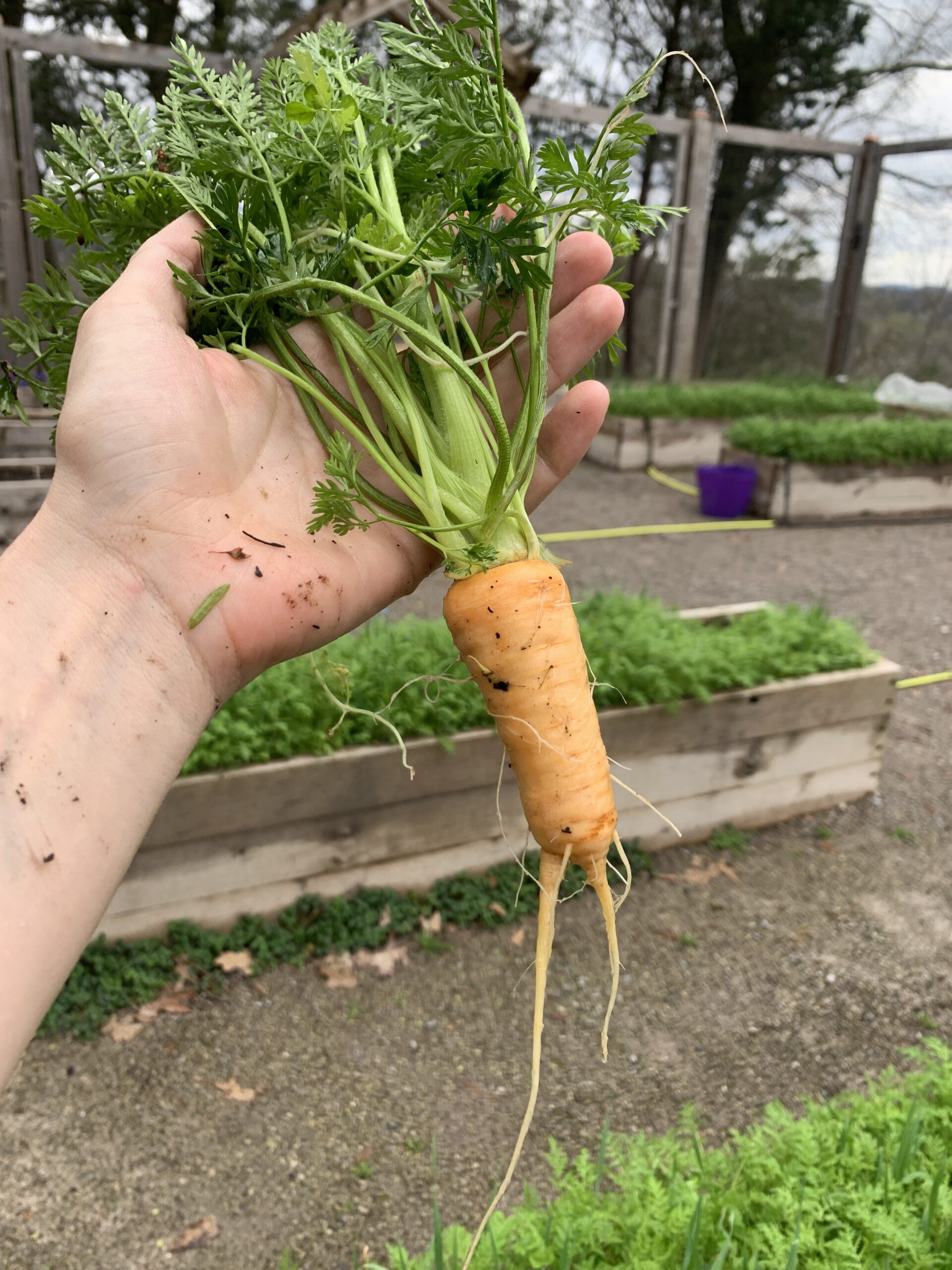
Featured Image: A carrot with personality.
Hello readers!
My name is Natasha, and I’m the Garden Educator at Cheekwood. My work here involves managing a raised bed vegetable garden (the Cheekwood GROWS Garden) and leading educational programming in this space. In this monthly blog series, I explore cultivated edible plants and our relationships with them in Middle Tennessee.
Carrots (Daucus carota) are a sign of spring throughout much of the United States. They are a slow-growing cool season vegetable, somewhat tolerant of frost and less fond of temperatures above 80° F. For growers in our region, that means there are two short windows for planting. Sow carrot seeds in August for a winter harvest, making sure to protect the plants with frost cloth once temperatures start to dip below freezing. Plant in March for a late spring harvest, keeping in mind that soil temperatures need to be at least 40° F for the seeds to germinate.
As their delicate foliage suggests, carrots can be fussy. They prefer finely sifted soil free of rocks or clumps of clay and can take up to 14 days to germinate. The seeds are so tiny that it is difficult to plant them at the correct spacing, meaning that thinning is usually required once or twice during the growing process.
Perhaps the hardest part of growing carrots is the wait time – the roots can take almost three months to fully enlarge! But eventually, they will begin to poke up out of the ground, a signal that it’s time to harvest. These enlarged roots are called taproots, an evolutionary adaptation allowing plants to push deep into the soil to collect and store water and nutrients. If you were to leave a carrot in the ground, it would continue to store energy in its taproot until the following year, when the plant would use the stored energy to put out lacy white flowers, and the root would turn tough and inedible.
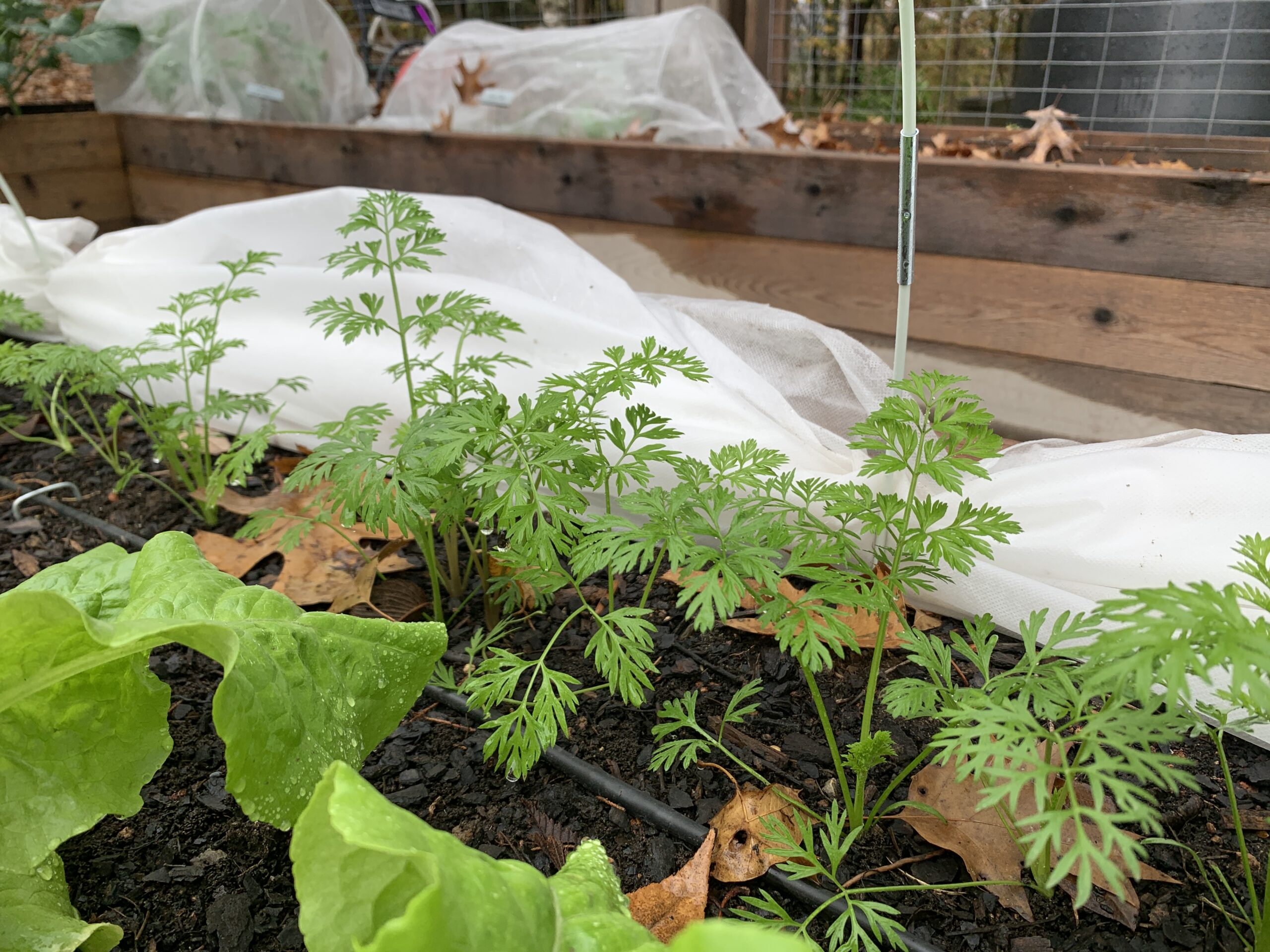
Carrots in an early stage of growth.
You may have seen these carrot flowers before, as the wild form of Daucus carota is a common roadside weed in much of North America. Often known as Queen Anne’s Lace, this plant is native to temperate regions of West Asia and Europe and categorized as invasive in some regions of the United States. In the wild, Daucus carota does not produce the enlarged roots that we love to crunch on, but the entire plant gives off an unmistakable carrot-y scent.
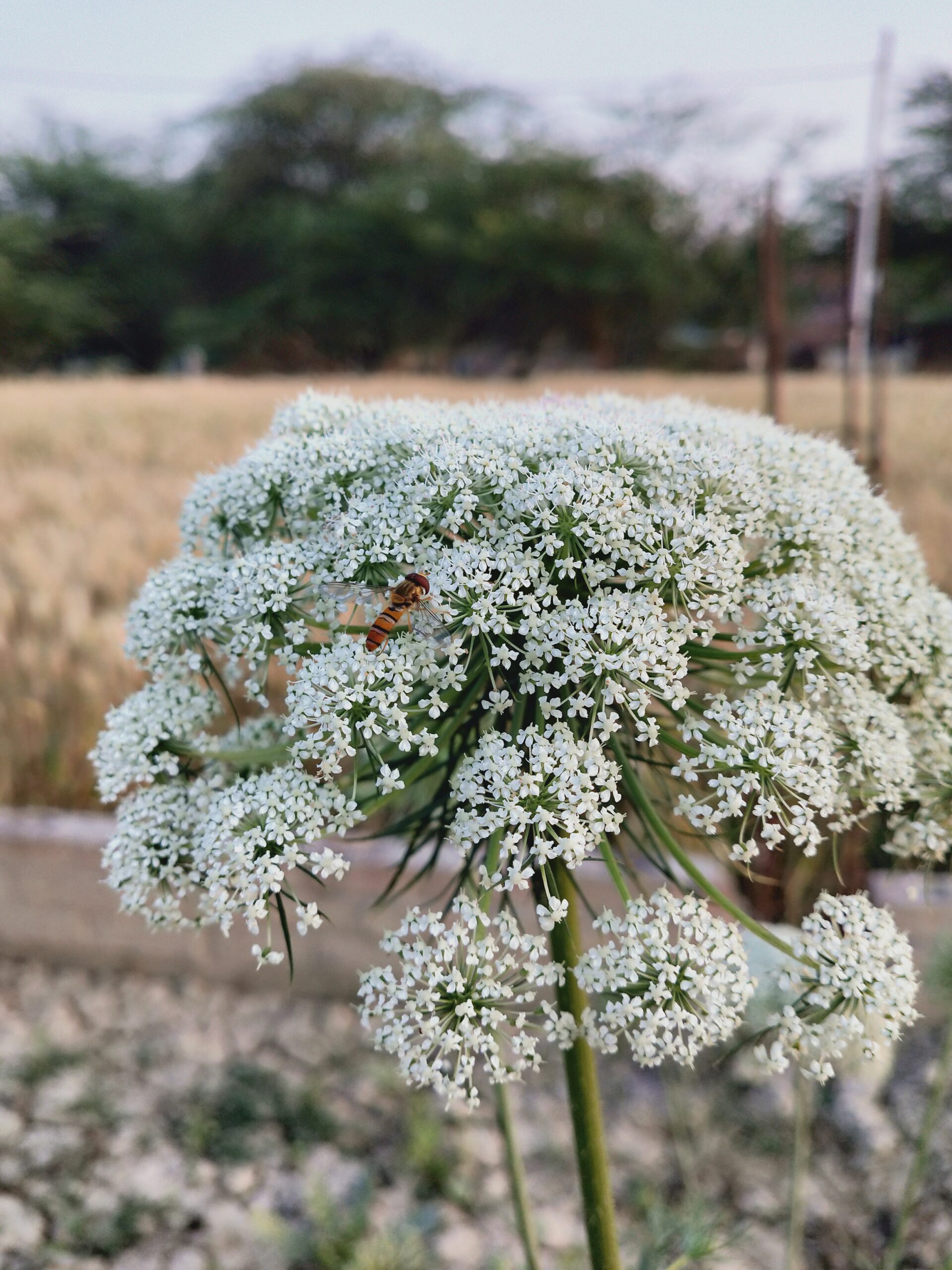
A wild, flowering carrot, also known as Queen Anne’s Lace.
This fragrance is emblematic of the carrot’s taxonomic family, called Apiaceae. Among this family’s members are culinary herbs that all boast delicate, distinctive scents: cilantro, parsley dill, fennel, and cumin. It’s therefore unsurprising that the first people to intentionally grow Daucus carota did not use the roots as a direct food source but instead harvested the delicately scented leaves and seeds for culinary seasoning and medicinal use. This initial carrot root cultivation took place in present-day Iran and Afghanistan, a region that remains a center of carrot diversity to this day.
It wasn’t until the 10th century that growers began selecting carrot plants with enlarged, colorful roots. The first carrots were purple and yellow, more akin to the rainbow carrots you might see at a farmer’s market than the orange ones on grocery store shelves. Orange carrots did not hit the scene until the 17th century, when Dutch farmers encountered a genetic mutation that caused carrot roots to produce higher quantities of carotenoids: chemical compounds that give many plants an orange hue. These orange carrots were sweeter than their counterparts and quickly gained popularity around the world.
The carrot’s arrival in North America is hard to pinpoint, but it’s clear that it was brought here by colonizers seeking to replicate European agricultural systems. Today, carrots are the fourth most-consumed vegetable in the United States, and their popularity is largely due to the innovation of a Californian farmer. For much of the 20th century, carrot farmers struggled to keep up with the trend towards large-scale mechanized agriculture. Americans increasingly expected aesthetic perfection in grocery stores, and carrots were inherently imperfect. By the 1980s, farmers were discarding more carrots than they were selling due to visual imperfections.

Springtime carrot tops.
Frustrated by this dilemma, farmer Mike Yurosek developed the “baby carrot,” using an industrial potato peeler to shave imperfect carrots down into snack-sized nubs. These were an instant hit, at once solving a waste problem, improving profits for farmers, and turning carrots into convenience food. Carrot consumption doubled within the following decade, and the crop earned its place in the agro-industrial complex. Today, two companies control over 60 percent of commercial carrot production in the U.S.
The nice thing about growing carrots in a home garden is that you don’t have to chop up your imperfect roots or contribute to our commercialized food system. Small seed companies offer endless variety when it comes to color, size, and shape, and I get my seeds from Southern Exposure Seed Exchange to access varieties especially suited to the South and support small farmers growing heirloom seeds. When you’re ready to harvest, see below for a carrot recipe that incorporates multiple parts of the plant as well as some of its Apiaceae relatives.
Roasted Carrots with Carrot Top Tahini Sauce
For the roasted carrots:
- 2 lb medium-sized carrots
- 4 tbsp extra virgin olive oil
- 1 tbsp ground cumin or lightly crushed cumin seeds
- 1/4 cup maple syrup or honey
- Salt to taste
For the carrot top tahini sauce:
- Juice and zest of 2 lemons
- 2 cloves garlic
- 2 cups carrot tops, coarsely chopped
- 1 cup dill, parsley, or cilantro, coarsely chopped
- 1/2 cup tahini
- 1/4 cup extra virgin olive oil
- Salt to taste
Instructions:
For the roasted carrots:
- Preheat oven to 425° F and line a sheet tray with parchment paper.
- Trim off carrot tops, cut carrots into thirds, then halve them lengthwise. Peeling is not necessary.
- In a large bowl, combine carrots, olive oil, cumin, maple syrup, and salt.
- Spread carrots onto sheet tray, making sure to space them evenly apart.
- Roast carrots in the oven for 30 minutes, or until fork tender and slightly caramelized.
For the carrot top tahini sauce:
- Combine lemon juice and zest, garlic, carrot tops, herbs, and olive oil in a blender. Blend until smooth, adding cold water as necessary to help the ingredients combine.
- Pour mixture into a medium bowl and add tahini. Whisk until fully incorporated, then season with salt to taste.
- Drizzle sauce over roasted carrots and enjoy!
If you have questions, comments, or suggestions for future topics, you can contact me at [email protected].
Sources:
- Carrot production statistic source: link